
Estimated reading time: 5 minutes
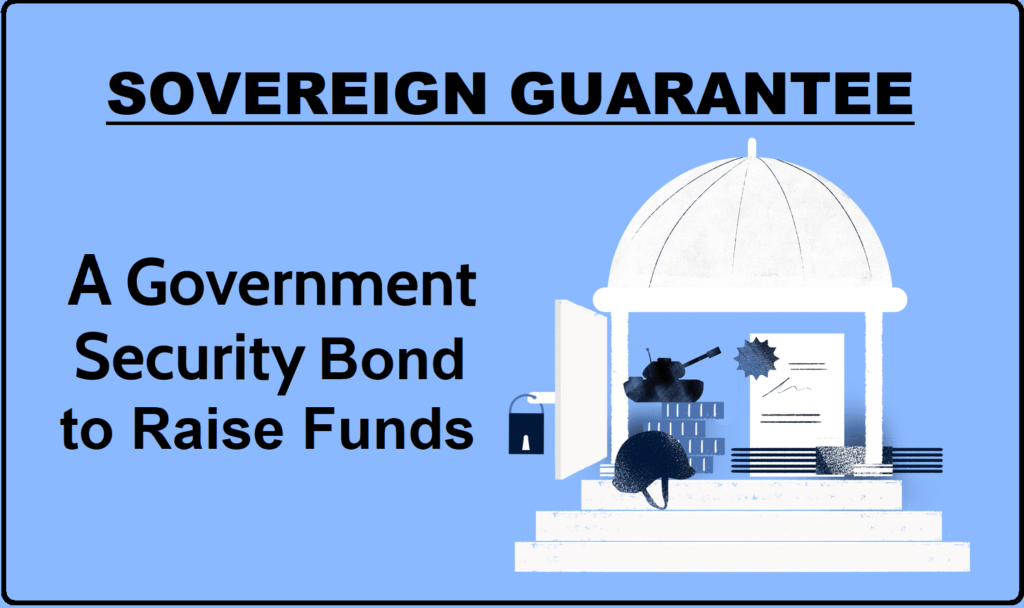
A Sovereign Guarantee is a formal commitment by a national government to assume the debt or contractual obligations of another party upon default. It operates as a state-backed risk-transfer mechanism in project and infrastructure finance.
Governments commonly use sovereign guarantees to support strategic projects where private borrowers lack sufficient credit strength. As a result, lenders gain confidence, while borrowers access financing on improved terms. This mechanism plays a central role in development finance and large-scale infrastructure delivery.
The Strategic Role of Sovereign Guarantee
When a government issues a sovereign guarantee, it shifts repayment risk from the borrower to the public sector. Consequently, lenders reduce exposure and price risk more efficiently. This structure enables capital mobilisation for projects that might otherwise remain unfunded.
In emerging markets, sovereign guarantees strongly support Foreign Direct Investment and concessional lending. They often appear in energy, transport, water, and industrial infrastructure projects. Moreover, they frequently accompany PPP and BOT structures, where long-term revenue risk concerns private investors.
Because of this role, sovereign guarantees act as financial stabilisers during early project phases. They reassure investors until projects achieve operational maturity and predictable cash flows.
Legal and Fiscal Conditions for Issuing Sovereign Guarantee
Not all governments can issue sovereign guarantees freely. Legal authority usually stems from public finance or budget legislation. In many jurisdictions, parliamentary approval is mandatory due to fiscal exposure.
International institutions such as International Monetary Fund and World Bank stress transparency when managing contingent liabilities. Governments must disclose guarantees clearly to avoid hidden public debt.
In cross-border projects, sovereign guarantees often include international arbitration clauses. Frameworks such as ICSID or UNCITRAL reduce enforcement uncertainty and address sovereign immunity concerns. These clauses materially increase bankability for foreign lenders.
Eligibility and Creditworthiness Considerations
Sovereign Guarantee depends heavily on the issuing country’s fiscal health. Lenders assess sovereign credit ratings, debt-to-GDP ratios, reserve adequacy, and historical repayment behaviour.
Countries with weak fiscal discipline face limitations. Excessive guarantees raise borrowing costs and may trigger rating pressure. Therefore, many governments impose internal caps on total guaranteed exposure.
In recent years, several countries tightened issuance rules to protect fiscal sustainability. As a result, sovereign guarantees increasingly target priority sectors aligned with national development goals.
Enforcement and Invocation of Sovereign Guarantee
If a guaranteed borrower defaults, lenders follow a defined enforcement sequence. First, they issue a formal notice of default. Then, they submit a payment demand under the guarantee terms.
Most sovereign guarantees operate as direct obligations, not secondary sureties. Therefore, lenders claim payment without exhausting remedies against the borrower. This structure resembles a demand guarantee rather than a conditional promise.
If disputes arise, enforcement proceeds through agreed arbitration forums or designated courts. Waivers of sovereign immunity play a decisive role. Without them, enforcement becomes complex and jurisdiction-dependent.
Expiry, Extension, and Adjustment of Sovereign Guarantees
Sovereign guarantees usually carry fixed validity periods. These periods often align with loan tenors or project milestones. Upon expiry, guarantees terminate automatically unless extended.
Extensions require formal approval and fiscal reassessment. Governments rarely extend guarantees without renegotiating exposure limits. Similarly, increasing guarantee amounts requires explicit amendments.
Unlike bank guarantees, sovereign guarantees do not circulate physically. Instead, they expire contractually or remain effective until obligations conclude.
Syndication and Combination with Other Guarantees
Sovereign guarantees can support syndicated financing structures. In such cases, multiple lenders rely on a single government undertaking. This approach spreads funding sources while maintaining risk comfort.
In some projects, sovereign guarantees coexist with bank guarantees or multilateral risk instruments. For example, lenders may combine partial sovereign backing with guarantees from development banks.
Institutions like Multilateral Investment Guarantee Agency often complement sovereign guarantees with political risk insurance. This layered structure reduces pressure on public balance sheets.
Risks and Fiscal Constraints
Despite their benefits, sovereign guarantees carry inherent risks. Poor governance may transform contingent liabilities into immediate fiscal shocks. Multiple simultaneous defaults amplify this danger.
The Organisation for Economic Co-operation and Development warns that weak monitoring obscures true public debt levels. Without disclosure, guarantees distort fiscal planning and investor perception.
Therefore, disciplined issuance and transparent reporting remain essential.
Due Diligence and Risk Mitigation Strategies
Lenders must assess sovereign guarantees with the same rigour as direct sovereign debt. Due diligence should cover legal enforceability, budget capacity, and political stability.
Common mitigation tools include exposure caps, escrow mechanisms, and staged guarantee activation. Multilateral partial risk guarantees further reduce sovereign burden.
According to recent MIGA data, guarantees increasingly catalyse private capital when structured prudently. However, excessive reliance weakens fiscal resilience.
A Double-Edged Fiscal Instrument
Sovereign guarantees function as powerful instruments of trust. Used carefully, they unlock capital, stabilise projects, and accelerate development. Misused, they threaten fiscal sustainability.
For governments, discipline determines success. For lenders, legal precision defines security. Balance remains the governing principle.
Final Note
Sovereign guarantees succeed only when credibility, transparency, and legal clarity align. They should support growth, not conceal risk. Effective governance transforms them into tools of confidence rather than liabilities of debt.
Check out more pages of our website for related content:
- Project Finance Agreement (Notarized) – 1
- Project Finance Agreement (Notarized) – 2
- Build Operate Transfer Agreement (B.O.T)
- Performance Bank Guarantee (PBG)
- Standby Letter of Credit (SBLC)
- Payment Bank Guarantee (BG) – 1
- An Ultimate Guide to the Different Guarantees (Blog Post)
Access the Full Contract Directory Index
You can browse the complete alphabetical list of all commercial, financial, and project-based contract templates by visiting our A–Z Contract Index.
References (Updated 2023–2025):
- European Investment Bank – “Sovereign and Sovereign-Guaranteed Lending 1998-2022.” March 2023.
- Overseas Development Institute (ODI) – “Guarantees for Development” 2014.
- ScienceDirect (Journal of Banking & Finance) – Sovereign loan guarantees and financial stability – This article finds that sovereign guarantees reduce banks’ default risk, increase credit availability, and have a small positive impact on economic output.
- IRENA (International Renewable Energy Agency) – Sovereign Guarantees – This article defines a sovereign guarantee as a government’s assurance that an obligation will be met if the primary obligor defaults, typically unconditional and backed by the full faith and credit of the government…

has been added to your cart!
have been added to your cart!

