Estimated reading time: 3 minutes
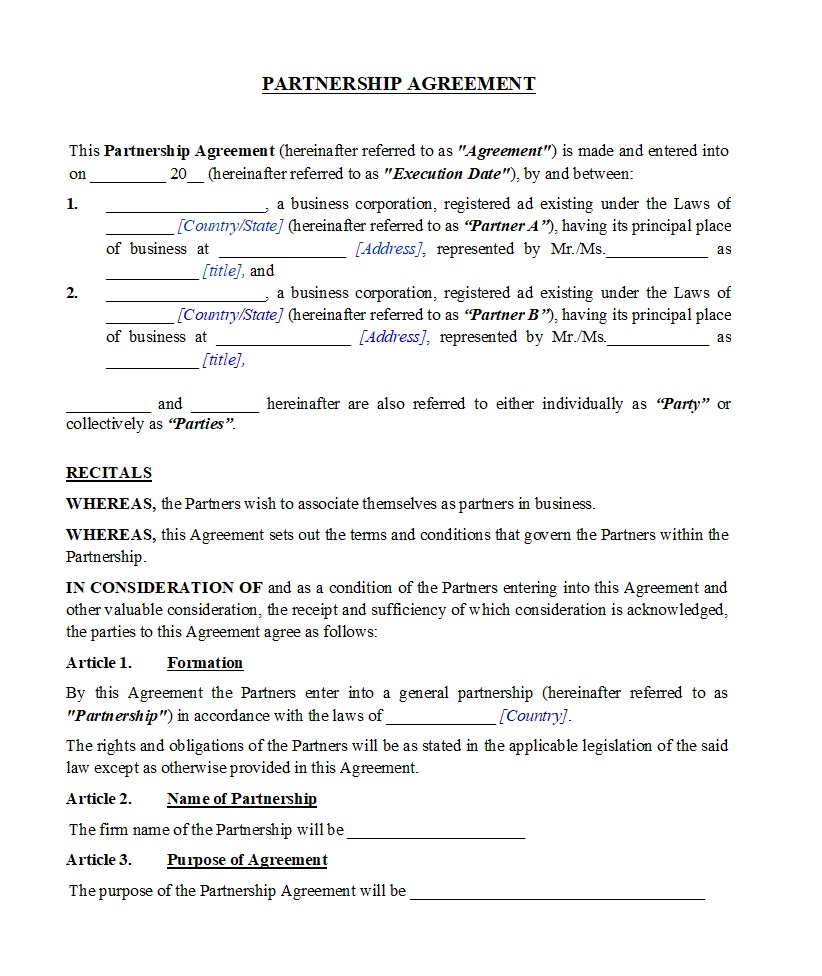
A Business Partnership Agreement is a foundational legal document governing how two or more parties operate a shared business venture. It transforms informal collaboration into a structured relationship by defining rights, duties, and expectations. More importantly, it allocates risk, clarifies authority, and creates enforceable rules before disputes arise.
In practice, partnerships often fail not because the business idea is weak, but because governance is unclear. This agreement addresses that gap by setting out how decisions are made, profits are shared, and responsibilities are enforced.

Purpose and Function of a Partnership Agreement
The primary purpose of a Business Partnership Agreement is to provide certainty. It establishes the legal framework that governs daily operations and long-term strategy. By documenting expectations in advance, partners reduce ambiguity and prevent reliance on assumptions or verbal understandings.
The agreement also functions as a reference point when disagreements occur. Courts and arbitrators rely on its terms to interpret intent, resolve conflicts, and enforce obligations.
Core Components
A well-drafted agreement identifies the type of partnership, such as a general partnership or limited partnership. It names each partner and defines their roles, authority, and decision-making power. Capital contributions, whether cash, assets, or services, are clearly recorded to avoid later disputes.
Profit and loss sharing, management duties, confidentiality, non-compete obligations, and exit mechanisms are typically included. These provisions ensure continuity if a partner withdraws, becomes incapacitated, or breaches the agreement.
Practical Use and Application
Partnership Agreements apply across industries, from professional services to trading ventures and project-based collaborations. They are especially important where partners contribute unevenly or where operational control must remain balanced.
In cross-border or regulated environments, the agreement also aligns the partnership with applicable laws and compliance requirements. Legal review is strongly advised to ensure enforceability and jurisdictional consistency.
Common Challenges and Mistakes
The most common mistake is using generic templates without adapting them to the business reality. Another risk is delaying documentation until after operations begin, when positions are already entrenched.
Failing to define exit rights, dispute resolution methods, or authority limits often leads to costly litigation. A precise and tailored Business Partnership Agreement prevents these outcomes by addressing risk early.
Final Note
A Business Partnership Agreement is not a formality. It is a governance tool that protects relationships, capital, and continuity. When drafted carefully and aligned with applicable law, it enables partners to focus on growth rather than conflict.
Check out more pages of our website for related content:
- Public–Private Partnership Project Agreement (PPP)
- Consortium Agreement
- Business Associate Agreement (BAA)
- Shareholders Agreement
- Profit-Sharing Agreement
Access the Full Contract Directory Index
You can browse the complete alphabetical list of all commercial, financial, and project-based contract templates by visiting our A–Z Contract Index.
References
- UNIDROIT – Principles of International Commercial Contracts
- UK Government – Set up a business partnership
- Cornell Law School – Legal Information Institute – Partnership

has been added to your cart!
have been added to your cart!

