Estimated reading time: 7 minutes
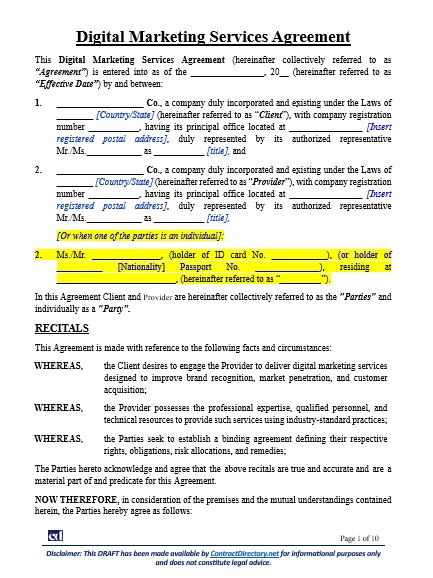
A Digital Marketing Service Agreement is a foundational document that governs the relationship between a business (the Client) and a digital marketing provider (the Agency). It transforms initial strategy discussions, proposals, and performance expectations into a legally binding framework.
In an era where digital marketing directly impacts revenue, brand visibility, data handling, and regulatory compliance, this agreement serves a critical operational role rather than a mere formality. When drafted effectively, it minimizes misunderstandings, manages risks, and safeguards both parties throughout the campaign lifecycle, from planning to execution and review.
Purpose and Function of A Digital Marketing Service Agreement
The core purpose of a Digital Marketing Service Agreement is to establish clear responsibilities and accountability before services commence. It outlines who handles what tasks, within what timelines, and under which constraints. This helps clients understand the realistic limits of marketing efforts, while agencies avoid vague or open-ended commitments.
By setting these boundaries early, the agreement prevents scope creep, uncontrolled expansions of project requirements, and ensures that performance evaluations are based on predefined benchmarks rather than subjective assumptions. Ultimately, it fosters a collaborative environment where both parties can focus on achieving mutual goals without legal ambiguities.

Core Components
A well-structured Digital Marketing Service Agreement includes several essential elements to ensure clarity and enforceability:
- Parties, Term, and Governing Law: Identifies the client and agency, specifies the agreement’s duration (e.g., fixed-term or renewable), and designates the applicable legal jurisdiction.
- Services Provided: Details the specific digital marketing activities, such as Search Engine Optimization (SEO), paid advertising (e.g., Google Ads or social media campaigns), content creation, social media management, analytics reporting, or conversion rate optimization.
- Payment Clauses: Outlines fee structures (e.g., flat fees, retainers, or performance-based), billing cycles, milestone payments, and penalties for late payments.
- Intellectual Property (IP) Provisions: Clarifies ownership rights over created content, creatives, data, and campaign materials—typically granting the client usage rights while protecting the agency’s proprietary methods.
- Confidentiality Clauses: Protects sensitive information like marketing strategies, customer data, and trade secrets from unauthorized disclosure.
- Indemnification and Limitation of Liability: Allocates responsibility for potential legal issues, such as platform violations or third-party claims, and caps damages to prevent excessive financial exposure.
These components form the backbone of the agreement, ensuring all aspects of the partnership are addressed upfront.
Performance Standards and Measurement
Digital marketing outcomes are influenced by unpredictable factors like algorithm changes, market competition, and consumer behavior. To account for this, the agreement should differentiate between effort-based obligations (e.g., timely delivery of campaigns) and outcome-based metrics (e.g., traffic growth or lead generation).
Service Level Agreements (SLAs) often emphasize measurable commitments, such as reporting frequency, response times to client queries, and execution quality, rather than guaranteeing specific results like top search rankings. This approach shields agencies from unrealistic demands while maintaining accountability through key performance indicators (KPIs) like click-through rates, engagement metrics, or return on ad spend (ROAS).
Provisions of the Digital Marketing Service Agreement in Practice
In real-world applications, the agreement incorporates practical provisions to support smooth operations:
- Scope and Deliverables: A detailed description of campaigns, timelines, and KPIs to avoid ambiguity.
- Compensation and Invoicing: Structures like retainers or bonuses tied to performance, with clear conditions for adjustments.
- Confidentiality and Data Privacy: Safeguards for personal data and analytics, ensuring compliance with regulations like GDPR or CCPA.
- Audit and Reporting Rights: Grants clients access to ad spend details, performance data, and third-party tools for transparency.
- Insurance Coverage: Requires the agency to maintain professional indemnity and cyber-liability insurance against risks like data breaches.
- Termination and Renewal: Specifies conditions for ending or extending the agreement, including notice periods and exit procedures.
- Dispute Resolution: Outlines steps like mediation or arbitration to resolve conflicts efficiently without resorting to court.
These provisions make the agreement adaptable to dynamic marketing environments.
Risk Allocation and Compliance
Digital marketing carries inherent risks due to regulatory requirements and ethical standards. The agreement addresses these through compliance clauses that mandate lawful practices, such as transparent advertising disclosures (e.g., #ad tags) and adherence to consumer protection laws.
Data privacy is a key focus, with provisions for secure handling of user information to avoid breaches.
Limitation of liability clauses protect against disproportionate claims from external disruptions, while indemnification ensures each party covers losses from their own actions. By allocating risks fairly, the agreement maintains ethical standards and minimizes potential legal or reputational damage.
Contract Structure and Supporting Agreements
Complex digital marketing relationships often use a multi-layered structure for flexibility. A Service Level Agreement (SLA) sets broad rules, including liability limits and IP principles. Campaign-specific details are handled in Statements of Work (SOWs), while SLAs define ongoing standards like uptime or reporting.
Non-Disclosure Agreements (NDAs) may stand alone to protect sensitive data. This modular approach allows for scalability, adding new campaigns via addenda, without overhauling the entire contract, creating a robust framework for long-term partnerships.
Practical Use and Application of Digital Marketing Service
Businesses use these agreements when outsourcing critical functions like growth hacking or online visibility to specialized agencies. For clients, it ensures predictable costs and deliverables; for agencies, it guarantees payment security and operational limits. In practice, strong agreements enable scalable campaigns, foster enduring partnerships, and facilitate regular performance reviews. They are particularly valuable in industries like e-commerce or tech, where digital strategies drive revenue.
Common Challenges and Mistakes
Despite their importance, pitfalls are common. Vague service descriptions can lead to disputes over what’s included. Promising “guaranteed” results exposes agencies to uncontrollable variables. Overly rigid terms may not adapt to evolving digital trends, while overlooking fine print can create hidden liabilities. To avoid these, parties should prioritize early clarification, involve legal experts, and regularly review the agreement to align with changing needs.
Business Relevance and Risk Management
In a fast-paced, data-driven field, digital marketing agreements act as risk-management tools. They mitigate financial and reputational threats by tying compensation to outcomes like impressions or conversions and ensuring regulatory compliance. For instance, GDPR-aligned clauses protect against data fines, while performance metrics promote accountability. This not only stabilizes operations but also enhances trust, allowing both parties to focus on innovation rather than potential conflicts.
Strategic Value in Digital Transformation
Beyond administration, these agreements are strategic assets in digital transformation. They blend creativity with governance, ensuring innovative campaigns operate within transparent, measurable boundaries. By supporting scalability across platforms and regions, they reinforce brand integrity and long-term positioning. In essence, a well-crafted Digital Marketing Service Agreement provides clarity, accountability, and confidence, enabling marketing ambitions to flourish under a solid legal foundation.
Conclusion
A Digital Marketing Service Agreement is far more than paperwork—it’s a commercial safeguard that aligns strategy, execution, and responsibility. When precise and tailored, it protects budgets, reputations, and relationships. Rushed or generic versions, however, can turn opportunities into liabilities. Businesses and agencies alike should invest in thoughtful drafting to maximize value in an ever-evolving digital landscape.
For further reference, you may review the following related templates:
- Marketing Agreement
- Letter of Authorization (For marketing negotiation)
- Co-Marketing Agreement
- Irrevocable Commission Payment Guarantee
- Commission Payment Guarantee
- Commission Agreement
- Influencer Marketing and Content Collaboration Agreement
- Irrevocable Master Fee Protection Agreement (IMFPA)
And also, reading this post on our Blog can be useful:
Glossary of Digital Marketing Terms
- Scope Creep
- The uncontrolled expansion of project requirements without corresponding adjustments to budget or timeline.
- Service Level Agreement (SLA)
- A component of the contract that defines measurable standards, such as reporting frequency and response times.
- Statement of Work (SOW)
- A detailed document within the agreement that specifies the exact deliverables, timelines, and tasks for a specific campaign.
- Indemnification
- The Agency’s promise to cover the Client’s losses if a marketing campaign results in third-party legal claims (e.g., copyright issues).
- Intellectual Property (IP)
- Legal rights over creative materials, copy, and data generated during the marketing process.
- ROAS (Return on Ad Spend)
- A common KPI that measures how much revenue a business earns for every dollar spent on advertising.
References
- Investopedia – Understanding Digital Marketing: Key Types, Channels, and Examples – This article explains digital marketing as the utilization of online platforms like websites, apps, and social media to promote and sell products and services.
- Adobe – What is digital marketing? Everything you need to know – The piece provides a comprehensive overview of digital marketing, highlighting its role in using digital channels to enhance brand awareness and achieve marketing objectives.
- SAS – Digital marketing: What it is and why it matters – This resource discusses digital marketing’s importance in leveraging internet and digital channels for brand promotion and building customer relationships. …

has been added to your cart!
have been added to your cart!

