Estimated reading time: 5 minutes

In the dynamic business landscape of 2026, where AI-driven tools and outsourced general counsel are reshaping corporate strategies, navigating a partnership exit requires precision. A Business Ownership Separation Agreement, also known as a Partnership Dissolution Agreement or Partnership Buyout Agreement, serves as the cornerstone for formally ending co-ownership in a shared company. This essential document ensures a clean legal, financial, and operational break, safeguarding both the exiting and continuing parties from future disputes, debts, and liabilities. Whether you’re a startup founder facing strategic conflicts or a seasoned entrepreneur restructuring for growth, understanding this agreement is crucial to protect your interests.
This comprehensive guide explores the purpose, key components, practical applications, common pitfalls, and best practices for drafting a robust Business Ownership Separation Agreement in 2026.
✅ What is a Business Ownership Separation Agreement and Why Do You Need One?
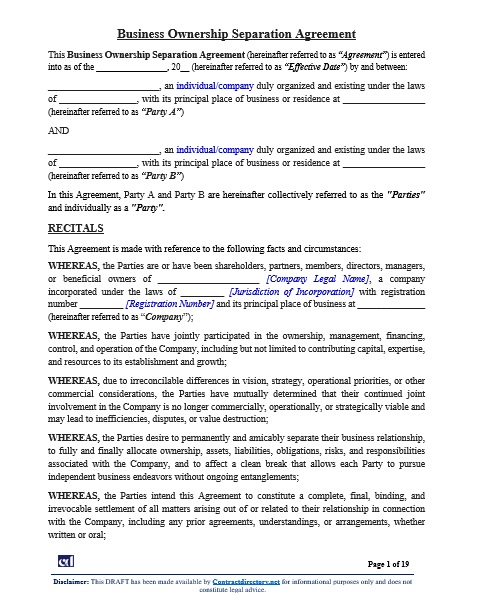
The Agreement is a legally binding contract that outlines the terms for one or more partners to exit a business partnership without destabilizing the company. It establishes a clear “separation date” as the cut-off for accounting, legal, and operational responsibilities, preventing overlaps between past and future obligations.
In 2026, amid rising trends in SaaS startups and employment law challenges, this agreement is more vital than ever. It protects against unforeseen risks like tax audits or creditor claims, ensuring the continuing party can operate independently. Without it, unresolved issues could lead to costly litigation, making it a must-have for any business restructuring. If you’re searching for a “startup lawyer” or “commercial contract lawyer,” consulting one early can tailor the agreement to your needs.
Benefits of a Partnership Dissolution Agreement
- Risk Mitigation: Shields parties from future claims, including those from heirs or estates.
- Financial Clarity: Allocates assets, liabilities, and guarantees fairly.
- Operational Continuity: Allows the remaining partners to focus on growth without interference.
- Legal Compliance: Aligns with evolving regulations, incorporating AI-assisted due diligence for accuracy.
✅ Core Components of a Robust Business Ownership Separation Agreement
To create an effective Partnership Exit Agreement, include these essential elements, drawn from best practices recommended by business law experts.
1. Identification of Parties and Separation Date
Precisely define the “exiting party” and “continuing party.” The separation date acts as the definitive cut-off for transferring ownership interests, such as shares or partnership quotas.
2. Ownership Transfer and Management Resignation
Detail the irrevocable transfer or cancellation of interests, free of encumbrances. Include resignations from roles like director or manager, plus a “Digital Exit Audit” for revoking access to SaaS credentials, API keys, and social media accounts—critical in today’s digital-first businesses.
3. Allocation of Assets, Liabilities, and Guarantees
Use schedules to divide tangible and intangible assets (e.g., intellectual property, inventory). Assign liabilities, debts, and tax exposures, with indemnities for post-separation obligations. For guarantees, mandate releases or substitutions, often backed by escrow or bonds.
4. Mutual Releases, Indemnities, and Fraud Protections
Provide full mutual releases from claims, binding on successors. Include indemnification for breaches and carve-outs for fraud, allowing clawbacks if misrepresentation is discovered.
5. Protective Clauses: Non-Compete, Confidentiality, and Non-Disparagement
Restrict the exiting party from competing or soliciting clients for a reasonable period. Enforce confidentiality for trade secrets and non-disparagement to preserve goodwill.
6. Dispute Resolution and Governing Law
Specify arbitration or mediation for disputes, governed by the relevant jurisdiction’s laws. In 2026, incorporate AI-mediated resolution options for efficiency.
✅ Practical Applications: When to Use a Business Partner Separation Agreement
This agreement is indispensable in scenarios like:
- Buyouts: One partner acquires another’s stake amid strategic shifts.
- Founder Disputes: Resolving irreconcilable differences without derailing the business.
- Restructuring: Preparing for fundraising, acquisitions, or board changes.
- Retirement or Exit: Smooth transitions for retiring partners.
Banks, investors, and “outsourced general counsel” often require such agreements to verify clear liability allocation. Without one, historical risks could jeopardize future deals.
✅ Common Challenges and Mistakes in Partnership Dissolution
Avoid these pitfalls when dissolving a partnership:
- Treating It Like an Employment Exit: Overlooks complex issues like debt allocation and tax audits.
- Ignoring Heirs and Estates: Fails to bind successors, risking delayed claims.
- Omitting Fraud Exceptions: Limits remedies for intentional misrepresentation.
- Neglecting Digital Assets: Leaves vulnerabilities in SaaS and online accounts.
- Poor Drafting: Vague terms lead to disputes; always consult a “business attorney near me” for customization.
In 2026, with trends like collaborative law and fixed-fee services on the rise, leveraging a “commercial contract lawyer” can close these gaps effectively.
✅ Best Practices for Drafting and Implementing in 2026
- Conduct Due Diligence: Use AI tools for financial reviews to ensure transparency.
- Seek Professional Help: Partner with a “startup lawyer” or “employment law attorney” for tailored advice.
- File Properly: Complete regulatory filings and notify stakeholders promptly.
- Plan for the Future: Include provisions for post-exit collaboration if amicable.
A well-drafted Business Ownership Separation Agreement isn’t just a formality, it’s a strategic tool for risk control, value preservation, and litigation prevention in serious businesses.
People also downloaded:
“Looking for a different framework? Browse our full A-Z Index of Legal Templates“
Glossary of Business Separation Terms
- Transferred Interests
- The collective shares, voting rights, and profit participation interests that the Exiting Party irrevocably relinquishes to the Continuing Party.
- Separation Date
- The definitive cut-off date used for all legal, accounting, and operational calculations, marking the end of the joint business relationship.
- Digital Exit Audit
- A mandatory security review to ensure all corporate credentials, API keys, and multi-factor authentication (MFA) are transferred and revoked from personal devices.
- Mutual Release
- An irrevocable discharge where both Parties forever drop all known and unknown claims against each other arising from their past business dealings.
- Counter-Indemnity Bond
- A financial guarantee provided to the Exiting Party if they cannot be immediately released from personal bank guarantees or corporate debts.
- Blue-Penciling
- A legal provision allowing a court to modify or narrow down “overbroad” non-compete clauses rather than cancelling them entirely.
References:
- BizVal – Navigating Business Partnership Separations – This article defines business partnership separation as the dissolution of a formal relationship between individuals who have formed a business together, offering guidance on handling such processes.
- Flagel & Papakirk LLC – 4 things to include in a separation agreement – The post highlights key elements to incorporate in a business separation agreement, such as protections against future liabilities and lawsuits.
- Rust Belt Legal – Business Separation Agreements: What You Need to Know – This resource explains a business separation agreement as a contract detailing the terms of dissolving a partnership or ownership structure. …

has been added to your cart!
have been added to your cart!

