Estimated reading time: 3 minutes
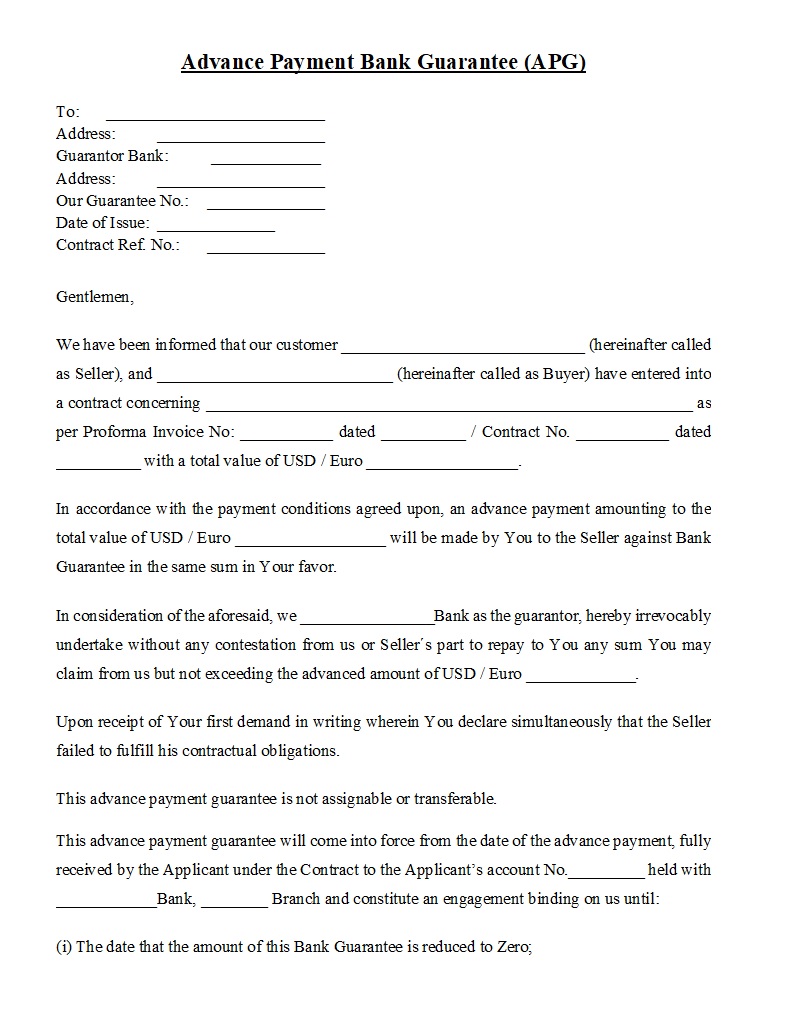
An Advance Payment Guarantee (APG) secures advance funds paid before performance begins. Buyers use it to protect cash exposure when contractors or suppliers receive upfront payments. The guarantee shifts repayment risk from the buyer to the issuing bank. As a result, contractual confidence increases at early execution stages.
Purpose and Function of an Advance Payment Guarantee
The primary function of an APG is risk protection. It ensures advance payments remain recoverable if performance fails. Therefore, buyers can release funds without relying solely on contractual promises. In large projects, this protection often becomes a precondition to contract effectiveness.
APGs also support execution flow. Contractors receive liquidity to mobilize resources early. Meanwhile, buyers retain financial security through the bank’s commitment.
Core Components
A valid APG is typically irrevocable. Once issued, it cannot be withdrawn unilaterally. It also operates on a first-demand basis, allowing the beneficiary to claim without proving default. Unconditional wording removes dependency on external approvals or disputes.
Extendability remains critical. Project delays frequently require guarantee extensions to maintain coverage. Without this feature, protection may expire before performance completes.
The guaranteed amount usually equals the full advance payment. However, where work or supply progresses gradually, the guaranteed sum may reduce proportionally. This reduction reflects completed performance and avoids over-securing the obligation.

Practical Use and Application
APGs commonly appear in construction, infrastructure, manufacturing, and large supply contracts. Buyers require them before releasing mobilization advances. Project owners rely on them during early execution when performance risk remains highest.
Contract managers should align APG validity with project timelines. They must also coordinate reduction mechanisms carefully to match certified progress. Misalignment often creates coverage gaps.
Common Challenges and Mistakes
A frequent mistake involves accepting conditional guarantees. Such wording weakens enforceability. Another risk arises when APGs expire before advances are fully amortized. Poor monitoring of expiry dates also exposes buyers unnecessarily.
Additionally, unclear reduction clauses can trigger disputes. Reduction should follow objective certification milestones, not informal progress claims.
Final Note
An Advance Payment Guarantee does not replace performance management. It stabilizes early execution risk. When structured correctly, it protects capital while enabling project momentum. Poorly drafted APGs, however, create false security and delayed recovery.
Check out more pages of our website for related content:
Access the Full Contract Directory Index
You can browse the complete alphabetical list of all commercial, financial, and project-based contract templates by visiting our A–Z Contract Index.
Reference:

has been added to your cart!
have been added to your cart!

