Brazil, South America’s largest economy, is a global trade powerhouse, leveraging vast natural resources, advanced agriculture, and strategic ports. This article provides an updated guide to Brazil’s trade advantages, infrastructure, regulations, agreements, and incentives, supported by 2024-2025 data. It integrates Double Taxation Treaties (DTTs) and key trade platforms, offering a comprehensive resource for businesses and investors.

1. Strategic Trade Advantages
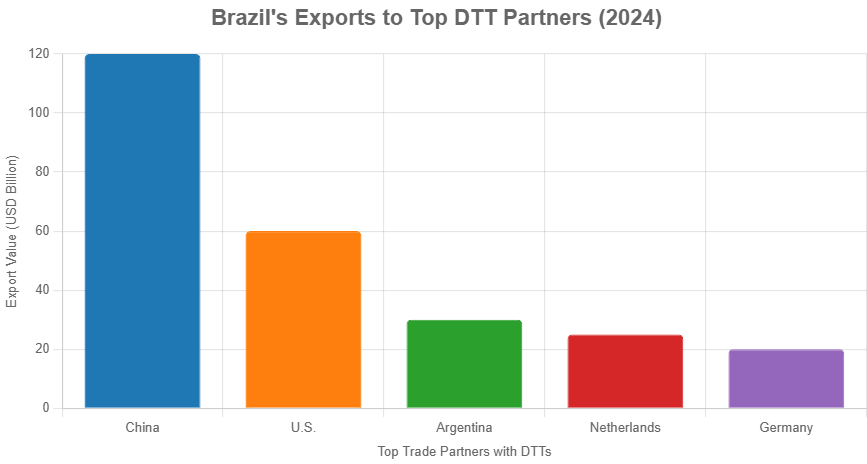
Brazil dominates global commodity markets, exporting soybeans, iron ore, beef, and coffee, with 2024 exports reaching USD 337 billion. Its mechanized agriculture, large consumer base (213 million people), and growing middle class drive economic vitality. Positioned along Atlantic shipping lanes, Brazil facilitates transatlantic trade with Africa and Europe. Key trade partners—China, the U.S., and the EU—benefit from robust bilateral ties, with China alone accounting for USD 120 billion in exports (2024).
The Strengths:
- World leader in soybeans, iron ore, beef, and coffee exports
- Highly mechanized agriculture with advanced technologies
- Growing consumer market and middle class
- Strategic Atlantic proximity for global supply chains
- Strong partnerships with China, U.S., and EU, bolstered by DTTs (see Section 9)
2. Major Ports
Brazil’s 7,400 km coastline hosts critical ports, handling 29% of trade through the Port of Santos (USD 174.43 billion, 5.4 million TEUs in 2024). Paranaguá supports agribusiness, exporting 43.3 million tonnes of grains. Investments of BRL 1.7 billion in 2025 aim to reduce congestion and enhance rail/road corridors.
Main Ports:
- Port of Santos: Largest port, handling bulk and containerized cargo
- Port of Paranaguá: Grain and agricultural export hub
- Port of Rio de Janeiro: Petroleum and industrial cargo center
- Port of Itajaí: Frozen meat, wood, and container specialist
.
3. Customs Regulations
Brazil’s customs, managed by Receita Federal do Brasil, require compliance via Siscomex, a digital platform for declarations. Importers and exporters must use HS codes, provide detailed invoices, and secure licenses for regulated goods (agriculture, health). Physical inspections and Brazil’s complex tax system demand accurate documentation to avoid delays or penalties.
The Requirements:
- Electronic Import Declaration (DI) via Siscomex
- Pre-shipment inspections for specific goods
- HS code classification and import licenses
- Coordination with MAPA (agriculture) and ANVISA (health)
4. Import and Export Procedures
Trade processes are document-intensive, requiring registration in RADAR and Siscomex Exportação. Importers submit quotations and licenses, while exporters register transactions and provide quality certificates. Timing with logistics agents is critical to prevent port bottlenecks.
Standard Documents:
- Commercial Invoice (detailed with HS codes)
- Bill of Lading
- Import Declaration
- Certificate of Origin
- Packing List
- Approvals from MAPA or ANVISA for regulated goods
5. Trade Agreements & Conventions
Brazil promotes regional integration via Mercosur, with a common external tariff and a concluded EU agreement (December 2024). It aligns with WTO, GATT, UNCTAD, and WCO for transparency and customs modernization. Bilateral FTAs with India, Israel, Egypt, and SACU expand market access.
Strategic Memberships:
- Mercosur: Free trade within South America
- WTO & GATT: Global trade rules and dispute resolution
- UNCTAD: Trade development support
- WCO: Modern customs practices
- FTAs: India, Israel, Egypt, Southern African Customs Union
6. Export Incentives & Barriers
Brazil supports exporters, especially SMEs, through tax incentives and APEX-Brasil’s market access programs. The Brasil Soberano Plan (2025) expands Reintegra (3% tax refunds) and Drawback (USD 10.5 billion in U.S. exports). However, complex taxes, customs delays, and infrastructure gaps pose challenges, requiring local consultants.
Incentives:
- Drawback Regime: Tax suspension on export inputs
- Reintegra: 3% tax refunds through 2026
- APEX-Brasil: Global market support and trade missions
Barriers:
- Overlapping tax regulations
- Prolonged customs clearance
- Regional infrastructure limitations
7. Trade Statistics Snapshot (2024)
Brazil’s 2024 trade surplus reached USD 74.6 billion, driven by commodity demand from Asia. Exports totaled USD 337 billion (soy, oil, iron ore, meat), with imports at USD 262.5 billion (machinery, electronics, chemicals). Diversification mitigates external shocks, with manufacturing exports hitting USD 181.9 billion.
Metrics:
- Exports: USD 337 billion
- Imports: USD 262.5 billion
- Top Partners: China, U.S., Argentina, Netherlands, Germany
- Surplus: USD 74.6 billion, second-highest historically
Chart: Brazil’s Exports to Top DTT Partners (2024)
This bar chart visualizes exports to key trade partners with DTTs, estimated from 2024 data.
8. Sample Trade Forms
Accurate electronic submissions via Siscomex prevent fines or shipment holds. Templates are available on the Receita Federal’s portal (see Section 10).
Required Forms:
- Declaração de Importação (DI): Electronic import declaration
- Registro de Exportação (RE): Export registration
- Certificate of Origin: Mercosur-compliant
- Commercial Invoice: Includes HS code and product details
- Packing List and Bill of Lading
9. Double Taxation Treaties (DTTs)
Brazil’s 34 DTTs, administered by Receita Federal, prevent double taxation on income, reduce withholding taxes (Brazil-Japan DTT, 1967, sets royalties at 12.5%), and promote investment. Recent ratifications (Poland, February 2025; Chile revisions, April 2025) enhance tax transparency.
Countries with Active DTTs (2024-2025):
- Argentina, Austria, Belgium, Canada, Chile, China, Czech Republic, Denmark, Ecuador, Finland, France, Germany, Hungary, India, Israel, Italy, Japan, Luxembourg, Mexico, Netherlands, Norway, Peru, Philippines, Portugal, Russia, Slovakia, South Africa, South Korea, Spain, Sweden, Switzerland, Turkey, UAE, Ukraine, UK, Venezuela
10. Websites for Exporters and Importers
These platforms, updated for 2025, streamline trade processes. PUCOMEX is Brazil’s single-window portal for customs, while RADAR registers traders.
- Siscomex: Manages import/export declarations, licenses, and clearance
- Receita Federal do Brasil: Oversees customs, taxes, and RADAR registration
- PUCOMEX: Single-window portal for trade procedures and digital submissions
- APEX-Brasil: Supports exporters with market intelligence and trade missions
- Banco Central do Brasil: Regulates foreign exchange for trade transactions
- MAPA: Issues sanitary/phytosanitary certificates for agricultural goods
- ANVISA: Regulates health-related goods (food, medicine, cosmetics)
- MDIC: Oversees trade policy and negotiations
1
References (2024-2025)
- Brazil’s trade balance records a surplus of $74.55 B in 2024
- FACTSHEET Mercosur-European Union Partnership Agreement
- Brazilian Tax Review
- Port of Santos Sets Historical Record for Cargo Throughput in 2024
1
Related Topics: #BrazilTrade #GlobalTrade #BrazilEconomy #CommodityExports #PortOfSantos #Mercosur #DoubleTaxationTreaty #TradeIncentives #BrazilExports #CustomsRegulations #TradeAgreements #Siscomex #APEXBrasil #BrazilPorts #TradeSurplus

