Estimated reading time: 4 minutes
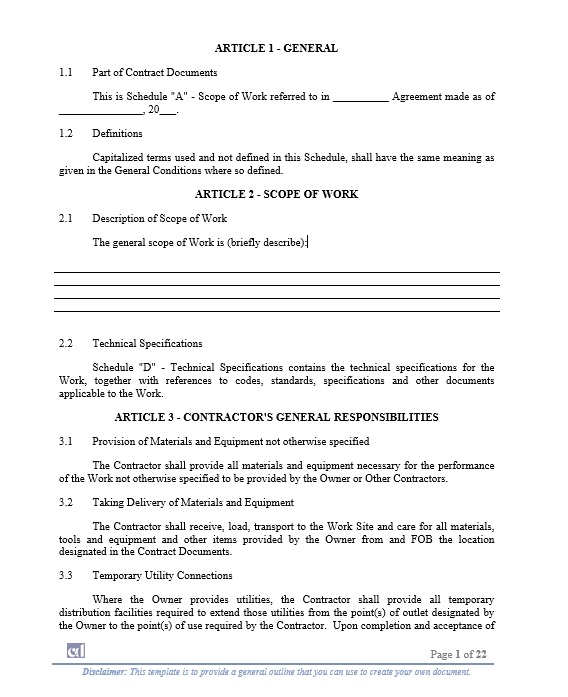
The Scope of Work (SOW) is a critical component in industrial project tenders because it clearly outlines responsibilities, deliverables, and expectations for all stakeholders involved. In practice, a well-defined SOW enhances transparency and, at the same time, significantly reduces ambiguity. As a result, it establishes a strong foundation for successful project execution. Moreover, by setting clear boundaries and objectives, the SOW aligns technical, commercial, and operational expectations from the outset. Therefore, presenting an effective template and clear drafting considerations becomes essential when preparing the Scope of Work for industrial project tenders.

Purpose of the Scope of Work
Primarily, the SOW serves as the contractual guide that defines the project’s overall framework. Specifically, it provides clarity to contractors, subcontractors, and project owners by detailing what is expected, when tasks must be performed, and how the work should be completed. Furthermore, it creates a common reference point that minimizes interpretation gaps between parties. Consequently, the document also plays a vital role during the tender evaluation stage, as it establishes measurable and comparable standards against which proposals can be assessed consistently
Essential Elements of the Scope of Work for Industrial Projects
- Introduction and Project Overview
Provide a brief description of the project, including objectives, such as increasing production capacity, enhancing safety systems, or commissioning new facilities; project location and specifications, such as a petrochemical plant, power station, or manufacturing unit; and, finally, the expected timeline for project completion.
- Scope of Work Definition
Detail the responsibilities of the contractor, including:- Engineering and design work. Procurement and supply of equipment and materials. Construction, installation, and commissioning activities. Testing, inspection, and quality assurance.
- Deliverables
List all expected deliverables with due dates, including:- Drawings, models, and technical documentation. Machinery, tools, or materials supplied. Installation reports and final commissioning certificates.
- Standards and Compliance
Specify industry codes, safety standards, and regulatory requirements.- Examples: ISO, ASTM, ASME, or local environmental and safety laws.
- Include quality benchmarks for all project phases.
- Project Milestones and Timeline
Provide a timeline with clear milestones for each project phase, such as:- Design and engineering: 3 months.
- Procurement and delivery: 5 months.
- Construction and installation: 6 months.
- Testing and commissioning: 1 month.
- Roles and Responsibilities
Define the roles of all involved parties, including the contractor, project owner, consultants, and subcontractors.
- Work Conditions
Describe the site conditions, accessibility, and any environmental constraints. Include:- Climate and terrain specifics.
- Security requirements.
- Working hours or local labor laws.
- Payment Terms
Link payments to project milestones and deliverables:- Initial payment upon contract award: 10%.
- Progress payments for completed milestones: 60%.
- Final payment after commissioning and acceptance: 30%.
- Performance Metrics and Penalties
To effectively monitor progress, define every detail for evaluating contractor performance, such as consistently meeting deadlines, adhering to quality and safety standards, and ensuring budget compliance. Additionally, include penalties for delays or non-compliance to maintain accountability.
- Change Management
To ensure alignment with project goals, establish a clear process for managing scope changes by including steps such as identifying, thoroughly evaluating, and formally approving modifications.- Documentation requirements.
- Approval processes.
- Cost and schedule adjustments.
Benefits of a Well-Defined Scope of Work
- Clarity: Minimizes misunderstandings among stakeholders.
- Efficiency: Streamlines the tender evaluation process.
- Risk Mitigation: Reduces potential for disputes and cost overruns.
- Accountability: Provides a basis for tracking performance and ensuring compliance.
Conclusion
A comprehensive and detailed Scope of Work is the backbone of any industrial project tender. It ensures all parties are aligned and provides a clear roadmap for project execution. By using this SOW template as a guideline, you can not only achieve project objectives but also minimize risks and uncertainties effectively.
Check out more pages of our website for related content:
- Construction Contract
- Engineering, Procurement and Construction Management Contract (EPCM)
- EPC Contract (Turnkey)
- Engineering, Procurement and Construction Contract (EPC)
Access the Full Contract Directory Index
You can browse the complete alphabetical list of all commercial, financial, and project-based contract templates by visiting our A–Z Contract Index.
Reference:
- Building Radar – What is ‘General Conditions’ in a Construction Contract
- PMI (Project Management Institute) – Practice Standard for Work Breakdown Structures -Explains how scope definition and deliverables are structured and controlled in complex projects.
- Mastt – Essential Contract Terms and Conditions Every Construction PM Should Know …

has been added to your cart!
have been added to your cart!

