Estimated reading time: 4 minutes
SaaS Legal Bundle gives founders a structured legal foundation for subscription software businesses. This article explains how this package protects revenue, controls risk, and strengthens investor confidence.
In 2026, regulators demand transparency and data discipline. Therefore, digital companies need organized documentation from day one. A complete SaaS Legal Bundle reduces exposure and accelerates market entry.
Purpose and Function of the SaaS Legal Bundle
A SaaS Legal Bundle aligns commercial strategy with regulatory compliance. It creates contractual clarity between provider and user. At the same time, it documents data handling practices. This structure reduces disputes and improves operational discipline.
First, the bundle defines service scope and usage limits. Then, it allocates liability and payment obligations. Moreover, it addresses data ownership and AI-generated outputs. Because SaaS businesses process user data continuously, privacy alignment remains essential.
The SaaS Legal Bundle also strengthens brand credibility. Customers review terms before onboarding. Investors review governance before funding. Clear documentation signals maturity and control. As a result, negotiations move faster.
Core Components
The SaaS Legal Bundle includes four integrated documents.
The Software as a Service (SaaS) Agreement governs subscription access. It defines service levels, uptime commitments, fees, and termination rules. It also regulates AI features and intellectual property rights. Furthermore, it clarifies limitation of liability and indemnity structure.
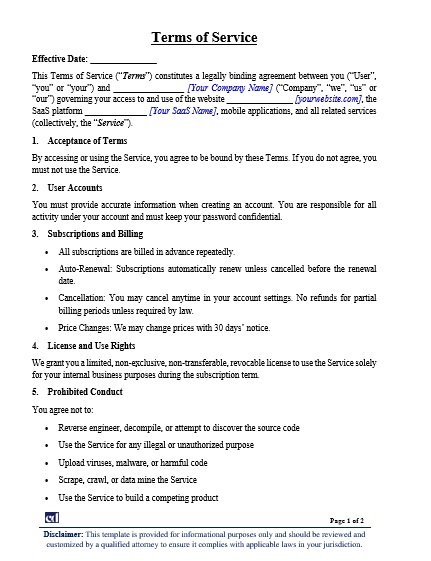
The Terms of Service regulate platform conduct. They address prohibited activities, account suspension, and auto-renewal clauses. Consequently, the provider maintains operational authority.
The Privacy Policy reflects GDPR and CCPA standards. It discloses data categories, processing purposes, and user rights. Therefore, users understand consent and access mechanisms.
The Cookie Policy details tracking technologies and third-party tools. It organizes cookie categories in structured tables. Hence, the company satisfies transparency obligations.
Together, these four documents form a unified SaaS Legal Bundle. Each document supports the others contractually and operationally.
Practical Use and Application
Startups often launch before formalizing documentation. However, early structure prevents later conflict. A SaaS Legal Bundle allows immediate customization. Founders replace company details and deploy the documents within minutes.
In fundraising, investors examine liability exposure and compliance posture. Structured contracts reduce due diligence friction. Therefore, the bundle improves negotiation leverage.
In cross-border operations, privacy documentation becomes critical. The European Commission enforces strict transparency duties. Meanwhile, California regulators impose disclosure standards. A properly drafted SaaS Legal Bundle addresses both frameworks.
Operationally, support teams rely on written terms. They reference suspension rights and payment conditions. This clarity reduces internal confusion. Consequently, customer disputes resolve faster.
Moreover, standardized templates lower legal expenditure. Early-stage companies avoid unnecessary drafting cycles. Instead, they adapt an established structure and request jurisdictional review.
Common Challenges and Mistakes
Many founders copy fragmented templates from random websites. This approach creates inconsistencies. One clause may contradict another. As a result, enforceability weakens.
Another mistake involves ignoring AI functionality. Modern SaaS tools generate automated outputs. Contracts must address ownership and responsibility clearly. Otherwise, disputes may arise.
Some companies overlook cookie disclosures. Regulators monitor tracking transparency closely. Inadequate notice exposes businesses to penalties.
Additionally, generic privacy texts often omit regional rights. Users may request deletion or data portability. Documentation must anticipate these requests.
Finally, founders underestimate renewal clauses. Subscription disputes often originate from unclear billing terms. Precise drafting prevents revenue conflict.
A structured SaaS Legal Bundle reduces these risks. It creates coherence across all documents. Therefore, the company operates with stronger contractual alignment.
Final Note
Professional documentation shapes how customers, regulators, and investors perceive a technology company. Structured agreements signal responsibility and operational control. While templates accelerate deployment, founders should still obtain jurisdiction-specific legal review. Clear contracts do not replace strategy, yet they support sustainable growth and reduce unnecessary exposure.
People also downloaded:
“Looking for a different framework? Browse our full A-Z Index of Legal Templates“
Reference:
- CookieScript – SaaS Privacy Policy Explained: Complete Guide – 2025 – This article details how a comprehensive SaaS Privacy Policy, as part of essential legal documentation, ensures transparency in data handling, complies with global privacy laws, and builds user trust for subscription-based platforms.
- Secure Privacy – SaaS Privacy Compliance Requirements: Complete 2025 Guide – The guide explains why SaaS companies need organized privacy and data discipline documentation from the start, including GDPR and CCPA alignment, to reduce exposure, handle user rights, and support scalable growth amid increasing regulatory demands.
- Termly – Privacy Policy for a SaaS Business: How To Create One – This resource outlines the role of integrated legal documents like Privacy Policies (alongside Terms of Service and related agreements) in protecting SaaS providers, ensuring compliance, minimizing disputes, and signaling operational control to customers and investors.

has been added to your cart!
have been added to your cart!

