Estimated reading time: 4 minutes

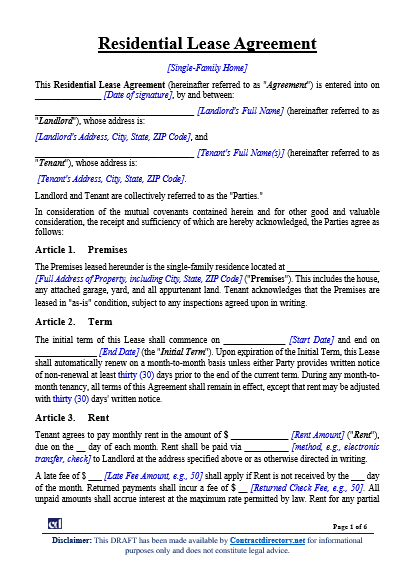
A Residential Lease Agreement governs the legal relationship between a landlord and a tenant for a private dwelling. It defines how a property may be used, how rent is paid, and how risks and responsibilities are allocated during occupancy. Because housing involves long-term possession and personal safety, this agreement establishes enforceable standards that protect both parties from uncertainty and dispute.
Purpose and Function of a Residential Lease Agreement
The agreement grants the tenant lawful possession of a residential property for a defined term. In return, the tenant commits to rent payment and proper use. Therefore, the landlord secures predictable income while retaining ownership. Automatic renewal and notice provisions also regulate how the tenancy continues or ends, reducing abrupt displacement or unlawful holding over.
Core Components
Key clauses define the premises, lease term, rent amount, payment method, and late charges. Security deposit rules control deductions and timelines. Utility allocation clarifies ongoing costs. Use restrictions preserve residential character. Maintenance provisions divide repair duties. Access rights balance privacy with inspection needs. Insurance, indemnity, and liability clauses allocate risk. Governing law and notice terms support enforceability.
Occupancy Rules and Lifestyle Controls
Residential leases regulate daily living conditions. Occupancy limits prevent overcrowding. Pet provisions manage noise, damage, and hygiene through addenda. Smoking and hazardous material restrictions protect safety. HOA compliance clauses avoid community violations. These controls maintain habitability while protecting neighboring properties and shared infrastructure.
Risk Management and Enforcement
Default clauses address non-payment, abandonment, and illegal use. Cure periods encourage compliance before escalation. Eviction and damage recovery remedies protect the landlord’s asset. Meanwhile, habitability standards and access limits protect tenants from misuse of authority. Insurance requirements further reduce loss exposure for both parties.
Practical Use and Application
This agreement applies to single-family homes, long-term rentals, and transitional housing. It supports stable occupancy while preserving asset value. Clear drafting reduces disputes over repairs, deposits, and termination. In regulated jurisdictions, compliance language aligns private contracts with statutory tenant protections.
Common Challenges and Mistakes
Vague maintenance duties cause repair disputes. Improper deposit handling triggers penalties. Missing renewal terms create uncertainty. Weak pet clauses invite damage. Incomplete notice provisions delay enforcement. Each omission increases legal friction during tenancy transitions.
Final Note
A Residential Lease Agreement is more than a rental form. It balances possession, income security, and personal safety. When drafted carefully, it prevents disputes and protects both housing stability and property value. Poor drafting, however, turns everyday living into a legal conflict.
People also downloaded:
“Looking for a different framework? Browse our full A-Z Index of Legal Templates“
Glossary of Residential Lease Terms
- Premises
- The specific property being rented, including the house, yard, and any attached structures like a garage[cite: 888, 889].
- Security Deposit
- A refundable payment held by the Landlord to ensure the Tenant follows all lease terms and returns the property in good condition[cite: 904, 906].
- Prorated Rent
- Rent adjusted for a partial month of occupancy, calculated based on the number of days the Tenant actually lives in the home[cite: 901].
- Right of Entry
- The Landlord’s legal right to enter the property for inspections or repairs, usually requiring at least 24 hours’ notice[cite: 934].
- Joint and Several Liability
- A legal rule stating that if multiple people sign a lease, each individual is 100% responsible for the full rent and any damages[cite: 964].
- Addendum
- An extra document attached to the main lease that adds specific rules, such as a pet policy or a smoking ban[cite: 921, 970].
Reference:
- Johns Hopkins University Wellbeing – How to read a rental contract – This blog post provides guidance on understanding and evaluating the key sections of a rental contract to ensure informed decision-making before signing.
- University of Michigan Off Campus Housing – Lease Terminology – The article explains essential terms commonly found in lease agreements to help tenants comprehend their rights and obligations.
- Fair Housing Foundation – California Tenants – A Guide to Residential Tenants’ and Landlords’ Rights and Responsibilities – This guide details the legal rights and responsibilities for both tenants and landlords in residential leasing, including key contract provisions and dispute resolution. …

has been added to your cart!
have been added to your cart!

