Estimated reading time: 3 minutes
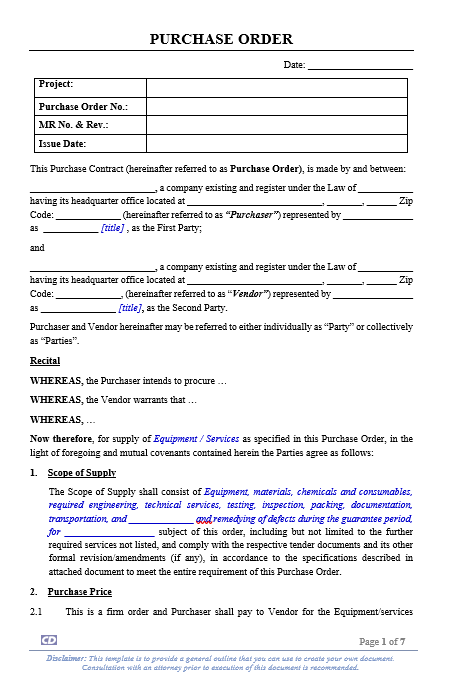
A Project Purchase Order is a comprehensive agreement between a purchaser and a vendor outlining the terms and conditions for supplying equipment and services. This document ensures clarity and mutual understanding, facilitating a smooth transaction process.
Scope of Supply
The scope of supply section of the Purchase Order details the materials, equipment, and services that the vendor must provide. It includes engineering services, technical support, testing, inspection, packing, documentation, and transportation. The vendor must remedy any defects during the guarantee period, ensuring compliance with the tender documents and all amendments. This section sets the foundation for the entire transaction, specifying what the vendor must deliver and under what conditions.

Payment and Delivery Terms
Payment terms of a Purchase Order outline the purchaser’s financial obligations to the vendor. The contract typically requires an irrevocable Letter of Credit (L/C) or Telegraphic Transfer (TT) for payments. An advance payment guarantees the vendor’s commitment, with subsequent payments linked to specific milestones, such as delivery and inspection approvals. Delivery terms, governed by INCOTERMS 2020, dictate the logistics, including the port of delivery and shipment schedules. The vendor is responsible for proper packaging and timely delivery, ensuring adherence to the agreed timeline.
Miscellaneous Provisions
Miscellaneous provisions cover additional terms essential for a Purchase Order execution. These include warranty periods, delay penalties, maximum liability, and documentation requirements. The vendor must provide a warranty for the equipment’s performance and bear the costs associated with any part replacements during the warranty period. Delivery delays attract liquidated damages, protecting the purchaser from financial losses. The order of precedence for contract documents ensures clarity and resolves any inconsistencies.
Purchase Agreement vs. Purchase Order (P/O)
Understanding the distinction between a Purchase Agreement and a Purchase Order (P/O) is fundamental to effective procurement management. While both documents serve as legally binding contracts between a buyer and a seller, they operate at different stages of the supply chain process. A Purchase Agreement is a high-level, long-term contract that outlines the overarching terms, conditions, and pricing for a sustained relationship, often without committing to specific delivery dates. In contrast, a Purchase Order is a transactional document used to initiate a specific shipment of goods or services under defined quantities and schedules. Essentially, the Agreement creates the legal framework and price stability, while the P/O acts as the tactical “trigger” that authorizes an individual transaction within that framework.
| Feature | Purchase Order (PO) | Purchase Agreement (PA) |
| Purpose | To execute a specific purchase | To set terms for recurring purchases |
| Timeframe | One-time and short-term | Long-term (usually a year or more) |
| Quantity & Date | Specifically defined | Flexible or unspecified |
| Commitment | Commitment to pay for that specific order | Commitment to collaborate under contract terms |
| Relationship | Transactional | Relationship-based |
Conclusion
A well-structured Project Purchase Order is crucial for successful procurement, ensuring both parties understand their responsibilities and the transaction proceeds smoothly. The Purchase Order minimizes disputes and fosters a collaborative relationship between the purchaser and vendor by clearly defining the scope, payment terms, delivery schedule, and miscellaneous provisions.
Check out more pages of our website for related content:
- Purchase Order (Terms and Conditions)
- Purchase Order (simple format)
- Performance Bank Guarantee – PBG (for Supply Equipment and
- Used Equipment Purchase & Sale Agreement
- Supply Agreement
Access the Full Contract Directory
You can browse the complete alphabetical list of all commercial, financial, and project-based contract templates by visiting our A–Z Contract Index.
References:
- International Federation of Consulting Engineers (FIDIC): Procurement Procedure Guide.
- Microsoft – Learn: Purchase orders for a project

has been added to your cart!
have been added to your cart!

