Estimated reading time: 3 minutes

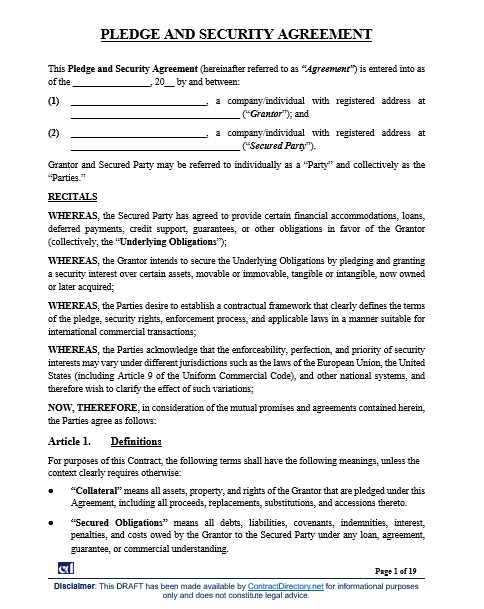
A Pledge and Security Agreement works as a contract that creates a legal charge over specific assets. It strengthens the creditor’s position and increases commercial certainty. The agreement often covers receivables, equipment, inventory, shares, and other movable properties. Creditors use it to reduce financial risk, while debtors use it to unlock funding. Consequently, the document supports structured finance, trade finance, and large commercial transactions.
Legal Nature and Purpose
The agreement creates a security interest that links an obligation to a defined asset. Parties use it when they want to guarantee repayment, secure performance, or support cross-border transactions. Creditors gain direct rights over the pledged asset. Furthermore, the debtor keeps ownership but accepts restrictions on use and disposal. The contract clarifies duties, default consequences, release conditions, and enforcement steps. Therefore, both sides enter the arrangement with full commercial clarity.
Situations Where the Agreement Is Legal
The agreement remains legal when the asset can be pledged, the pledgor holds valid ownership rights, and the law of the jurisdiction recognises secured transactions. Many countries regulate this through specific systems. For example, the United States uses secured-transaction rules under its commercial code. The European Union applies harmonised regimes that support movable-asset securities. Other regions, such as the Middle East and Asia, rely on registration systems that confirm the creditor’s priority. As a result, the agreement aligns with global business practices.
Requirements for a Valid Agreement
Parties must identify the asset clearly, state the secured obligation, and sign the contract with full consent. Many jurisdictions demand registration to finalise the creditor’s priority. This step may appear as filing a financing statement or recording the pledge in a secured-interests registry. Clear wording, complete commercial terms, and full disclosure reduce risk. Consequently, the agreement protects lenders, borrowers, and potential third parties.
Commercial Uses
Businesses rely on this agreement in high-value financing, acquisition deals, supply-chain transactions, international trade, and credit facilities. Lenders use it to secure loans, while companies use it to raise capital quickly and efficiently. Moreover, investors use it in complex structures such as syndicated loans, mezzanine finance, and private credit deals. The document fits almost any industry because it creates control, reduces disputes, and ensures proper enforcement rights.
Conclusion
A Pledge and Security Agreement gives stability to financial deals. It increases lender confidence and gives borrowers access to funding. It operates in both domestic and international markets, and it adheres to recognized legal standards in most jurisdictions.
Check out more pages of our website for related content:
Access the Full Contract Directory Index
You can browse the complete alphabetical list of all commercial, financial, and project-based contract templates by visiting our A–Z Contract Index.
References:
- World Trade Organization – “Trade Finance and SMEs: Bridging the Gaps in Provision”
- U.S. Small Business Administration – “Pledging Assets to Secure a Loan”
- World Economic Forum – “The Role of Secured Transactions in Economic Growth”
- Harvard Business School – “Collateral and Credit Structures in Modern Finance”

has been added to your cart!
have been added to your cart!

