Estimated reading time: 4 minutes
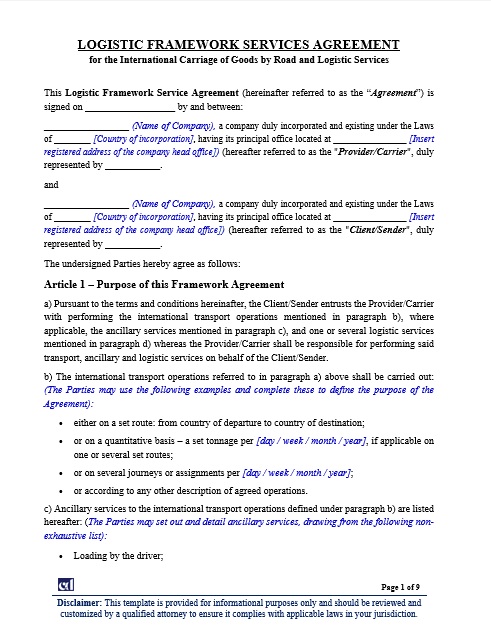
A Logistic Framework Service Agreement structures long-term cooperation between a carrier and a sender for international road transport and integrated logistics. It consolidates recurring shipments, warehousing, customs handling, and distribution under one master contract. For cross-border road carriage, it operates alongside the Convention on the Contract for the International Carriage of Goods by Road, ensuring uniform liability and documentation standards.

Purpose and Function of A Logistic Framework
A Logistic Framework Service Agreement defines the overall relationship, while each shipment forms a separate carriage contract. This structure reduces repetitive negotiations and clarifies operational expectations.
The framework typically covers:
- Defined transport routes or agreed volumes
- Ancillary services such as loading, stowing, unloading, and customs formalities
- Broader logistics services including warehousing, stock control, and order assembly
- Documentation obligations, especially the CMR consignment note
Under the CMR regime, liability rules, limitation amounts, and time bars apply automatically to qualifying international road transport. The framework aligns commercial pricing and operational cooperation with those mandatory rules.
For businesses managing structured trade flows, this agreement stabilizes capacity, pricing logic, and risk allocation.
Core Components
A well-drafted Logistic Framework Service Agreement addresses commercial, operational, and legal layers simultaneously.
First, pricing models must match the logistics reality. The agreement may use flat rates, volume-based remuneration, exclusive fleet allocation, or hybrid structures. Fuel adjustments and tax pass-through clauses protect cost balance.
Second, liability and compensation clauses require precision. While CMR governs carriage liability, logistics services outside pure transport fall under the chosen governing law. The agreement must distinguish clearly between these regimes.
Third, insurance coverage must reflect cargo value and operational risk. Cargo liability insurance, general liability, and compliance-driven policies should be documented and verifiable.
Fourth, subcontracting and transshipment rules must be explicit. In cross-border trade, uncontrolled subcontracting increases exposure and enforcement complexity.
Finally, force majeure provisions must align with sanctions risk, border closures, and regulatory disruptions. The contract should not contradict mandatory CMR defenses.
Practical Use and Application of a Logistic Framework
Companies rely on Logistic Framework Service Agreements when:
- Shipments occur frequently between fixed jurisdictions
- Warehousing and transport operate under one service chain
- Distribution networks require structured reporting and KPIs
- Cross-border compliance forms part of the daily workflow
The framework reduces transactional friction. Instead of negotiating each shipment, parties issue transport or logistics orders under the master structure.
Operational tools such as SOPs, performance standards, and reporting schedules often appear as exhibits. This transforms the agreement from a legal instrument into a management framework.
Where disputes arise, carriage issues follow CMR jurisdiction rules. Logistics disputes follow the governing law clause. That separation prevents confusion.
Common Challenges and Mistakes
Many companies underestimate the structural complexity of a Logistic Framework Service Agreement. As a result, they draft provisions that appear coherent but fail under operational pressure.
First, one frequent mistake involves mixing transport liability with warehouse liability. In practice, CMR limitation does not automatically extend to storage periods unless the contract clearly structures the service chain. Therefore, without precise drafting, liability gaps quickly emerge. Moreover, courts may separate the transport phase from the warehousing phase, which further complicates claims handling.
Second, documentation often creates avoidable exposure. For example, missing or inaccurate CMR consignment notes weaken enforcement and reduce the chance of successful claims recovery. Consequently, even a valid claim may face procedural resistance. In addition, inconsistencies between shipment orders and delivery records can undermine evidentiary strength.
Furthermore, unclear fuel adjustment mechanisms regularly trigger disputes. Unless price fluctuation clauses define objective triggers, calculation formulas, and review periods, disagreements become inevitable. Accordingly, transparency in adjustment methodology protects both parties.
Finally, non-compete or exclusivity clauses require commercial realism. While protection of business interests remains legitimate, overly broad restrictions discourage operational flexibility. In turn, such clauses may face enforceability challenges under competition principles. Ultimately, a framework contract must remain commercially workable and strategically balanced, not merely legally comprehensive.
Final Note
A Logistic Framework Service Agreement supports predictable international road transport and integrated logistics. However, its structure must reflect CMR boundaries, insurance coverage, subcontracting control, and pricing logic. Businesses that align operational practice with contractual clarity reduce disputes and strengthen supply chain stability.
People also downloaded:
“Looking for a different framework? Browse our full A-Z Index of Legal Templates“
References
European Commission – Mobility and Transport – Logistics and multimodal transport – This European Commission page outlines the EU’s policy framework for creating a favorable environment for logistics services, including multimodal and combined transport operations that integrate road carriage with other modes under structured agreements to enhance efficiency and sustainability in freight logistics.
European Commission – Mobility and Transport – Multimodal and intermodal freight transport – This page explains the EU legal and policy framework (including the Combined Transport Directive) for multimodal freight transport, where road legs are combined with rail, inland waterways, or short sea shipping under overarching agreements to promote efficient, interconnected, and sustainable international logistics services.
European Commission – Road Transport: EU Rules and Market Access

has been added to your cart!
have been added to your cart!

