Estimated reading time: 3 minutes
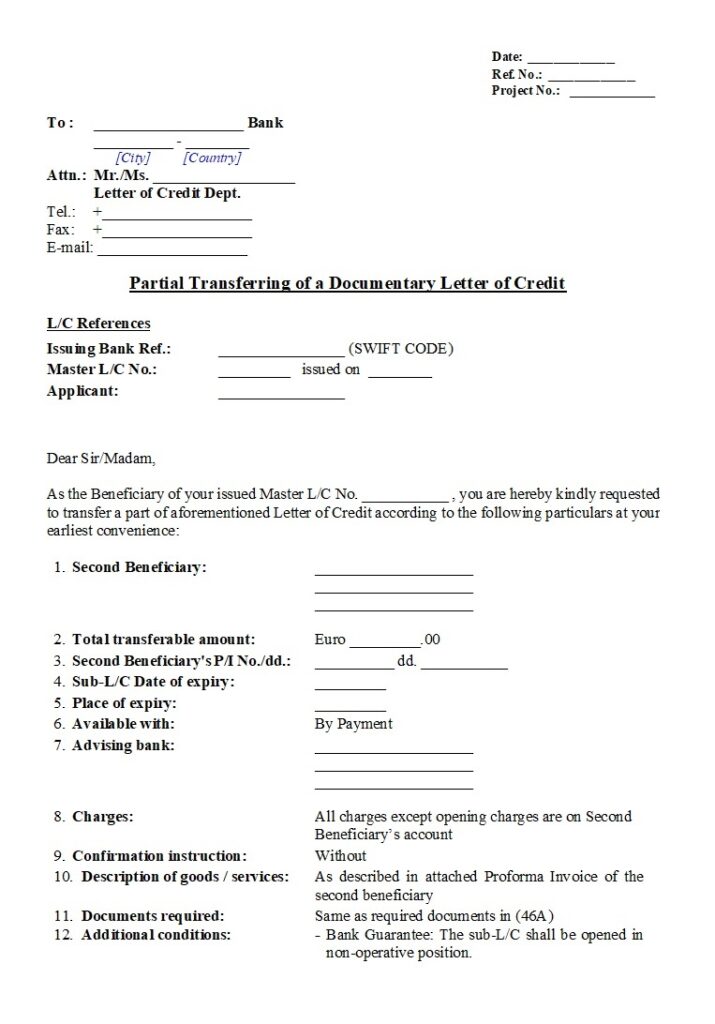
An LC Partial Transferring Form applies when a transferable and divisible Letter of Credit allows the first beneficiary to allocate portions of the credit to other parties. This situation often arises in supply chains involving vendors or sub-contractors. The form provides a structured way to request partial transfers while keeping the master LC intact.
Purpose and Function of an LC Partial Transferring Form
The main purpose of an LC Partial Transferring Form is to divide the credit amount under one master LC among several second beneficiaries. It allows the primary beneficiary, often a supplier or main contractor, to pass on payment rights without issuing new payment instruments. As a result, payment flows stay aligned with the original LC structure and bank controls remain centralized.
Core Components
The form records precise transfer instructions. It identifies the master LC and confirms that it is both transferable and divisible. It then specifies the amount allocated to each second beneficiary. Names, addresses, and banking details must be accurate, as banks rely on this data for execution.
All transferred portions remain subject to the terms of the master LC. No condition may be relaxed unless the LC expressly permits it. This ensures consistency across all partial transfers and protects the issuing bank from unintended exposure.
A mandatory attachment is the proforma invoice or approved quotation of each second beneficiary. An original document is usually preferred. This attachment justifies the transfer amount and links the payment to an actual underlying transaction.
Practical Use and Application
In practice, the main beneficiary submits the completed LC Partial Transferring Form to the transferring bank. The bank reviews compliance with the master LC terms. If acceptable, it executes separate partial transfers in favor of each second beneficiary.
This mechanism is common in construction, trading, and manufacturing contracts. It supports layered supply arrangements while avoiding multiple independent LCs. It also improves transparency, as all payments remain traceable to the original credit.
Common Challenges and Mistakes
A frequent mistake is attempting partial transfer under a non-divisible or non-transferable LC. Banks will reject such requests outright. Another issue arises when attached invoices do not match the transferred amounts. Even minor discrepancies can delay processing.
Errors in beneficiary details also cause rejections. Since partial transfers are document-driven, accuracy is critical. Finally, parties sometimes assume that terms can be modified for second beneficiaries. Unless the master LC allows it, this assumption is incorrect and risky.
Final Note
The LC Partial Transferring Form is a control tool, not a formality. It preserves the integrity of the master LC while enabling multi-party payment structures. When prepared carefully and supported by proper invoices, it allows complex transactions to function smoothly without increasing banking risk.
Check out more pages of our website for related content:
- Letter of Credit Application Form
- How a Letter of Credit (L/C) Works?
- Everything About Letter of Credit
Access the Full Contract Directory Index
You can browse the complete alphabetical list of commercial, financial, and project-based contract templates in our A–Z Contract Index.
Reference:
- CreditManagementWorld.com – Transferable letter of credit – This article explains transferable letters of credit, including how transfers can be full or partial, the reasons for using them (e.g., by export brokers), applicable UCP 600 rules, and limitations on changes during partial transfers.
- ICC Academy – Transferable vs Back-to-back letters of credit (LCs) – This resource compares transferable LCs (where one LC can be partially or fully transferred to a second beneficiary) with back-to-back LCs, highlighting key roles like the advising bank and practical use in trade finance for intermediaries.
- Drip Capital – Transferable Letter of Credit – Process Flow, Risks & Samples – This piece details transferable LCs, noting that the first beneficiary can transfer the credit wholly or in part to one or more second beneficiaries, with requirements like buyer approval and associated risks in the process. …

has been added to your cart!
have been added to your cart!

