Estimated reading time: 4 minutes

A Landscaping Services Contract governs the legal relationship between a property owner and a landscaping contractor. It defines scope, payment, risk allocation, and performance standards. This article explains how the agreement structures project-based and ongoing services while protecting both parties from disputes and operational uncertainty.
The structure analyzed below reflects a comprehensive Landscaping Services Contract template landscaping contract.
🌲 Purpose and Function of a Landscaping Services Contract
A Landscaping Services Contract establishes clear expectations before physical work begins. Landscaping often involves excavation, irrigation, grading, planting, and hardscape construction. Each activity carries cost, safety, and liability implications.
Therefore, the agreement defines the services in detail. It may attach drawings, specifications, or proposals as exhibits. This prevents scope ambiguity.
It also confirms property ownership and authority. The customer must have legal control over the property. Otherwise, unauthorized improvements could create legal exposure.
Additionally, the contract distinguishes between:
• One-time project services
• Ongoing maintenance services
This distinction affects pricing, termination rights, and scheduling obligations.
In short, the agreement converts informal landscaping discussions into enforceable commercial obligations.
🌲 Core Components
The agreement contains several operational pillars.
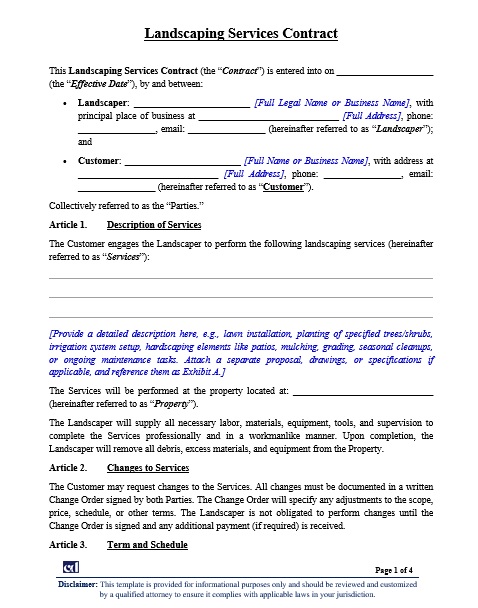
First, the Description of Services clause defines deliverables. It identifies the property location and confirms that the landscaper provides labor, materials, equipment, and supervision.
Second, the Change Order mechanism protects both sides. Landscaping conditions often evolve due to soil issues, hidden utilities, or client revisions. A written change order prevents verbal disputes.
Third, the Payment Terms clause structures cash flow. Project-based services typically require deposits, milestone payments, and final payment after walkthrough. Ongoing services rely on periodic invoicing. Late fee provisions encourage discipline.
Fourth, Representations and Warranties ensure compliance with licensing, insurance, and applicable regulations. The customer must also disclose site hazards and underground utilities.
Fifth, Insurance and Liability provisions allocate risk. The landscaper maintains general liability and workers’ compensation coverage. However, the agreement excludes liability for pre-existing damage, force majeure, or third-party interference.
Sixth, Termination rights allow structured exit. Material breach triggers cure periods. For ongoing services, termination may occur with advance notice.
Finally, Governing Law and Dispute Resolution clauses define jurisdiction and mediation procedures. This reduces procedural uncertainty.
🌲 Practical Use and Application of a Landscaping Services Contract
This agreement applies to residential, commercial, and mixed-use properties. It is particularly relevant where:
• Irrigation systems require technical installation
• Hardscaping involves structural elements
• Large planting projects demand phased performance
• Maintenance services span multiple seasons
For commercial property managers, a detailed contract protects budgeting discipline. For contractors, it secures payment rights and limits exposure. Importantly, landscaping intersects with building codes, environmental rules, and HOA restrictions. Therefore, the contract ensures regulatory alignment before execution.
Additionally, the subcontractor clause permits delegation while preserving contractor responsibility. This flexibility supports operational scalability. Thus, the Landscaping Services Contract operates as both risk shield and performance roadmap.
🌲 Common Challenges and Mistakes
Many disputes arise from vague scope definitions. Words like “Garden Improvement” lack measurable standards. Another common issue involves undocumented changes. Verbal modifications create billing conflicts.
Payment disputes also emerge when milestone percentages remain unclear. Precision prevents cash flow interruptions. Liability misunderstandings frequently occur regarding underground utilities. If the customer fails to disclose hidden infrastructure, damage risk increases.
Finally, termination clauses must balance fairness and enforceability. Excessively rigid provisions can trigger unnecessary litigation.Therefore, disciplined drafting and written documentation throughout the project lifecycle remain essential.
🌲 Final Note
A Landscaping Services Contract transforms aesthetic plans into structured legal commitments. It allocates financial risk, clarifies performance standards, and supports long-term maintenance relationships. Although landscaping appears operational, its contractual framework determines whether the project proceeds smoothly or deteriorates into dispute.
“Looking for a different framework? Browse our full A-Z Index of Legal Templates“
Reference:
- American Society of Landscape Architects – The Landscape Architect’s Guidelines Construction Contract Administration – This resource from ASLA provides detailed guidelines for landscape architects on administering construction contracts, including procedures, responsibilities, risk management, and best practices for successful project implementation in landscaping services.
- National Association of Landscape Professionals – Protecting Your Business: Why You Need Contracts, Not Handshakes – This article explains the importance of written contracts in the landscape industry and highlights key elements such as scope of work, indemnity clauses, payment terms, and termination provisions to protect landscape service providers.
- Structure Studios – How to Write Landscaping Contracts: 5 Essential Elements– This guide outlines five critical components to include in landscaping contracts—detailed project description, payment terms, change orders, warranties, and liability protections—to ensure clarity and reduce disputes in landscaping service agreements.
- Southern State Landscape – HOA Landscaping Contracts: 7 Clauses To Watch For – This article discusses essential clauses in landscaping contracts for homeowners associations, including flexibility in services, liability, insurance, and alignment with HOA rules and standards.

has been added to your cart!
have been added to your cart!

