Estimated reading time: 3 minutes
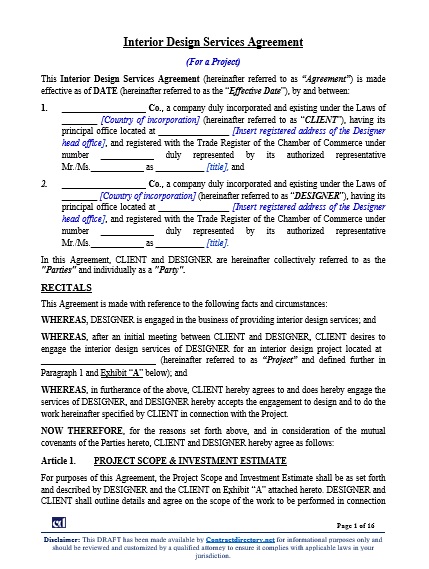
An Interior Design Service Agreement sets the legal and commercial framework between a client and an interior designer. It goes far beyond aesthetics. This contract manages expectations, controls cost exposure, defines responsibility boundaries, and reduces disputes. Whether the project is residential or commercial, a well-structured agreement protects both sides from scope creep, delays, and liability misunderstandings.

Purpose and Function of an Interior Design Service Agreement
The primary function of an Interior Design Service Agreement is clarity. It establishes what the designer will do, what the client must provide, and where responsibility ends. Design projects often evolve, and without a clear contractual baseline, even small changes can trigger conflict.
This agreement also separates design intent from construction responsibility. Designers typically provide conceptual and visual guidance, not architectural or engineering services. The contract formally records that distinction, preventing incorrect assumptions during execution.
Core Components
A standard Interior Design Service Agreement starts with a clear scope of services. This includes design phases such as conceptual design, detailed design, selection of finishes, furniture specifications, and presentation deliverables. Each phase usually has defined outputs and a limited number of revisions.
The financial structure is another central element. Fees may be flat, phased, or tied to purchasing and execution. Most agreements confirm that design fees and reimbursable expenses are non-refundable. Payment timing, late fees, and suspension rights are clearly stated.
Timelines and delays are addressed to manage client-driven slowdowns. Contracts often extend deadlines automatically when approvals or information are delayed.
Liability limitations are critical. Designers usually cap their liability to fees paid or available insurance coverage. Warranties for materials and products remain with suppliers, not the designer.
Practical Use and Application
In practice, the agreement operates as a project control tool. It governs how revisions are handled, how changes are priced, and how approvals are documented. Change order mechanisms allow flexibility without losing control.
The contract also regulates purchasing. When items are sourced through the designer, pricing structures and trade discounts are addressed upfront. This avoids disputes over margins and transparency.
For projects involving construction or renovation, the agreement defines the designer’s coordination role without assigning contractor responsibility. This distinction is essential for risk management.
Common Challenges and Mistakes in an Interior Design Service Agreement
A common mistake is relying on informal proposals instead of a full agreement. Short documents rarely address delays, scope expansion, or termination consequences.
Another frequent issue is ignoring revision limits. Unlimited revisions quickly erode timelines and budgets.
Clients also underestimate the importance of liability and warranty clauses. Designers are often blamed for supplier defects unless the contract clearly allocates responsibility. Missing clauses on termination, document use, photography rights, and confidentiality often surface only after disputes begin.
Final Note
An Interior Design Service Agreement is not a formality. It is the backbone of a professional design relationship. When drafted properly, it balances creativity with structure, flexibility with control, and ambition with legal protection. Every interior design project benefits from a clear contractual foundation.
People also downloaded:
“Looking for a different framework? Browse our full A-Z Index of Legal Templates“
Reference:
- AIA Contract Documents – Summary: B152™–2019, Standard Form of Agreement Between Owner and Architect for Interior Design and Furniture, Furnishings, and Equipment (FF&E) Design Services This official summary describes AIA Document B152–2019, a standardized agreement specifically designed for interior design and FF&E services between owners and architects/design professionals, outlining purpose, structure, and key provisions.
- AIGA – AIGA Standard Form of Agreement for Design Services This resource presents AIGA’s modular standard agreement for design services (updated in recent years), offering a flexible framework with basic terms, intellectual property provisions, fees, expenses, and conditions adaptable to creative disciplines including aspects relevant to interior design. …

has been added to your cart!
have been added to your cart!

