Estimated reading time: 5 minutes
Introduction of INCOTERMS 2020
INCOTERMS 2020 are the latest set of international commercial terms published by the International Chamber of Commerce (ICC). Effective since January 1, 2020, these rules define the responsibilities, costs, and risks between buyers and sellers in the delivery of goods during cross-border transactions.
They do not cover ownership transfer, payment terms, or breach of contract — those are handled separately in the sales contract. Instead, Incoterms focus on key logistics questions: Who arranges transport? Who pays for insurance? When does risk pass from seller to buyer? Using the correct Incoterm helps avoid misunderstandings, disputes, and unexpected costs.
Why Businesses Rely on INCOTERMS 2020
Companies across the world use Incoterms to simplify trade contracts. These terms give all parties a shared understanding of duties and costs. When both sides know what to expect, they avoid delays and miscommunication. Therefore, international commercial terms make deals faster and more efficient. This is especially useful when working with different legal systems and customs rules.
Changes in Incoterms 2020 Compared to 2010
- DAT renamed to DPU: Delivered at Terminal (DAT) became Delivered at Place Unloaded (DPU) to clarify that the named place can be anywhere (not just a terminal), and the seller must unload the goods.
- FCA updated for sea transport: Sellers can now agree to provide an onboard bill of lading when goods are handed to the carrier.
- CIP insurance level increased: CIP now requires higher coverage (ICC A or equivalent) by default, while CIF remains at minimum coverage (ICC C).
- Security obligations highlighted: More emphasis on export/import security clearance responsibilities.
- Better explanatory notes: Each rule starts with user-friendly notes to help choose the right term.
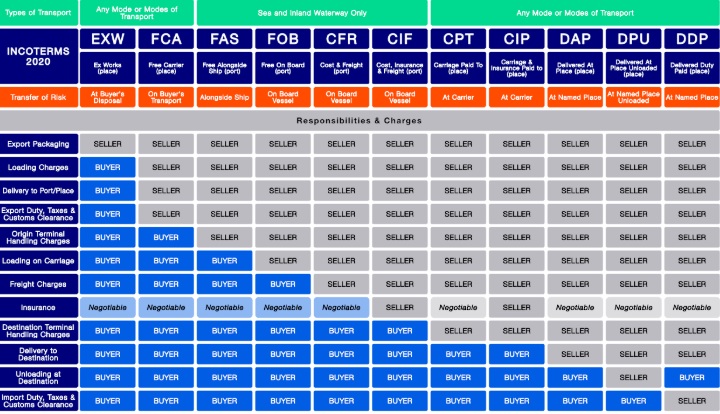
Incoterms 2020 still include 11 rules, divided into two groups:
7 Rules for Any Mode of Transport (Air, Road, Rail, Multimodal)
- EXW – Ex Works (… named place) The seller makes goods available at their premises. The buyer handles all transport, export clearance, and risks from that point. Minimal seller responsibility.
- FCA – Free Carrier (… named place) Seller delivers goods, cleared for export, to a carrier or place nominated by the buyer. Risk transfers when goods are handed over. Updated in 2020 to allow onboard bills of lading in some sea cases.
- CPT – Carriage Paid To (… named place of destination) Seller arranges and pays for transport to the destination. Risk passes to buyer when goods are handed to the first carrier.
- CIP – Carriage and Insurance Paid To (… named place of destination) Like CPT, but seller also obtains insurance (higher level in 2020: ICC A or equivalent). Ideal when buyer wants seller to cover insurance.
- DAP – Delivered at Place (… named place of destination) Seller delivers goods ready for unloading at the named place. Seller handles transport and export clearance; buyer does unloading and import clearance.
- DPU – Delivered at Place Unloaded (… named place of destination) Seller delivers and unloads goods at the named place. Highest seller responsibility among multimodal rules (replaced DAT in 2020).
- DDP – Delivered Duty Paid (… named place of destination) Seller delivers goods, cleared for import, with all duties/taxes paid. Maximum seller responsibility; buyer only unloads.
4 Rules for Sea and Inland Waterway Transport Only
- FAS – Free Alongside Ship (… named port of shipment) Seller delivers goods alongside the ship at the port. Buyer handles loading, freight, and risks from that point.
- FOB – Free On Board (… named port of shipment) Seller loads goods on board the vessel. Risk transfers once goods are on board. Classic sea term.
- CFR – Cost and Freight (… named port of destination) Seller pays freight to the destination port. Risk passes when goods are on board at shipment.
- CIF – Cost, Insurance and Freight (… named port of destination) Like CFR, but seller also provides minimum insurance (ICC C). Common for container sea shipments.
How to Choose the Right Incoterm 2020 Rule
- Consider mode of transport — use sea-specific rules (FAS, FOB, CFR, CIF) only for ocean freight.
- Evaluate level of control — EXW gives buyer most control; DDP gives seller most.
- Think about insurance — Use CIP for better coverage; CIF for minimum.
- Factor in experience — New importers often prefer DDP or DAP to reduce risk.
- Always specify the exact place (e.g., “Incoterms 2020 FCA Shanghai Port”) and version (“2020”) in the contract.
Why Use Incoterms 2020 in Your Contracts?
Clear allocation of costs and risks reduces disputes, speeds up negotiations, and ensures smoother international shipments. Always refer to the official ICC Incoterms® 2020 publication for full legal details, as interpretations can vary by jurisdiction.
Check out more pages of our website for related content:
Access the Full Contract Directory Index
You can browse the complete alphabetical list of all commercial, financial, and project-based contract templates by visiting our A–Z Contract Index.
References
- International Chamber of Commerce (ICC) – Incoterms® 2020 – This official resource provides a comprehensive introduction to the 11 rules that define the responsibilities of buyers and sellers in international trade, including key 2020 updates such as the transition from DAT to DPU.
- International Trade Administration – Know Your Incoterms – This article clarifies the essential tasks, costs, and risks associated with global shipping and explains how these internationally recognized rules function within sales contracts.
- Trade Finance Global – Incoterms 2020 [UPDATED 2025] – This guide offers a detailed breakdown of all current trade terms, including infographics and expert insights on choosing the most advantageous rule for different modes of transport. …

has been added to your cart!
have been added to your cart!

