Estimated reading time: 3 minutes

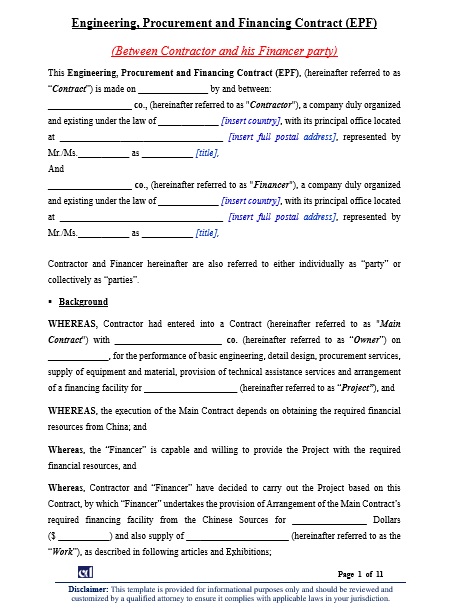
(This Contract is to be signed between an EP Contractor and his Financer for a jointly cooperation in an EPF contract)
⏺ How an Engineering, Procurement and Financing Contract Works
▶ Engineering: Crafting the Blueprint
The engineering phase involves developing detailed designs and specifications that align with the project’s objectives. This stage ensures that all technical requirements are meticulously planned, facilitating a seamless transition to procurement and construction.
▶ Procurement: Acquiring Essential Resources
During procurement, the contractor sources and purchases all necessary materials and equipment. Effective procurement strategies are crucial to maintaining project timelines and budgets, as they ensure the availability of quality resources when needed.
Procurement vs. Purchasing in Construction
- Procurement (The Strategic Process)
- A holistic, multi-step lifecycle involved in acquiring everything needed for a project. It encompasses researching, selecting, negotiating, managing delivery, and overseeing installation to ensure long-term value and project alignment.
- Purchasing (The Tactical Transaction)
- A specific subset of the procurement process. It refers strictly to the financial transaction—the act of issuing a purchase order and paying for materials, services, or equipment required for the project.
- Key Distinction
- While often used interchangeably, purchasing is simply one stage within the broader procurement framework. Procurement focuses on the “how and why,” while purchasing focuses on the “how much and when.”
▶ Financing: Securing Project Funding
The financing component sets EPF contracts apart by incorporating financial arrangements into the project scope. Contractors often collaborate with financial institutions to secure funding, reducing the financial burden on project owners and enhancing project feasibility.
⏺ Advantages of EPF Contracts
EPF contracts offer several benefits, including streamlined project management, reduced administrative burdens, and improved risk allocation. By entrusting a single entity with engineering, procurement, and financing, project owners can focus on core operations while ensuring project success.
Conclusion
In summary, EPF contracts provide an integrated solution for project delivery, combining design, resource acquisition, and financing. This holistic approach enhances efficiency, reduces risks, and supports successful project outcomes.
Check out some other pages of our website for related content:
- Engineering, Procurement, and Construction Contract (EPC)
- Engineering, Procurement and Construction Management Contract (EPCM)
- Engineering, Procurement, Construction and Finance Agreement (EPCF)
- Engineering, Supply and Training Contract (EP)
- Project Implementation Contract
- Purchase Order (For Project)
- Funding Guarantee
References
- World Bank (PPP Resource Center): PPP Resource Center – Provides comprehensive templates for EPC contracts, which often serve as the base for EPF agreements. Their resources are the global standard for Public-Private Partnerships (PPPs).
- FIDIC (Silver Book): FIDIC Silver Book Overview – The “Conditions of Contract for EPC/Turnkey Projects” is the industry-standard starting point. While it doesn’t always include financing terms out of the box, it is the primary legal framework onto which a “Finance” (F) clause is added…

has been added to your cart!
have been added to your cart!

