
Estimated reading time: 4 minutes
An Engineering, Procurement, Construction and Finance (EPCF) Contract provides an integrated framework for delivering capital-intensive projects under a single contractual structure. Unlike traditional EPC models, an EPCF Contract links technical execution directly with project financing, allowing the owner to rely on one coordinated delivery and funding mechanism.
This contract model appears most often in large infrastructure, energy, mining, and industrial developments where project complexity and funding scale require aligned technical and financial responsibility.
Structure of an EPCF Contract

Engineering: Defining the Technical Foundation
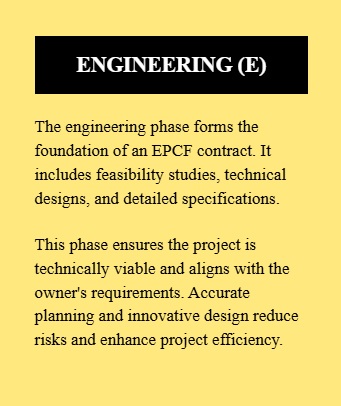
The engineering phase establishes the technical backbone of an EPCF Contract. It covers feasibility analysis, conceptual and detailed design, technical specifications, and performance criteria. This stage ensures that the project meets regulatory, operational, and lender requirements. Accurate engineering reduces design changes, supports cost certainty, and forms the basis for financing approvals. In EPCF projects, lenders rely heavily on engineering outputs to assess technical risk and long-term viability.
Procurement: Securing the Supply Chain
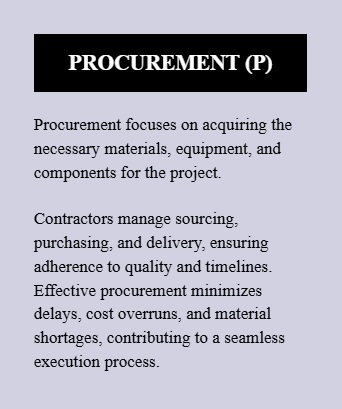
Procurement under an EPCF Contract manages the sourcing of equipment, materials, and services required for construction. The contractor controls supplier selection, contract negotiation, logistics, and delivery scheduling. Effective procurement protects the project against price volatility, supply delays, and quality failures. Because financing drawdowns often depend on procurement milestones, this phase directly connects technical progress with financial disbursement.
Construction: Executing the Project
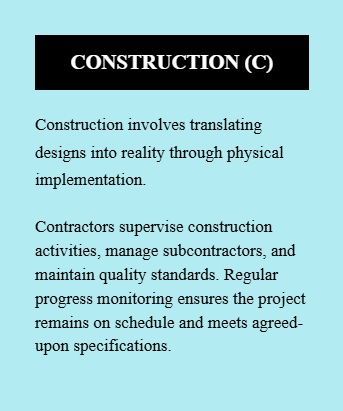
Construction transforms approved designs into a functioning asset. The contractor coordinates site activities, manages subcontractors, enforces safety and quality standards, and monitors progress against the schedule.
In EPCF arrangements, construction obligations link closely to completion tests, performance guarantees, and repayment triggers. Timely and compliant construction protects both the owner’s operational objectives and the lenders’ security.
Finance: Integrating Capital and Delivery
Financing distinguishes EPCF from standard EPC contracts. Under an EPCF structure, the contractor or a consortium arranges funding through commercial banks, development finance institutions, export credit agencies, insurers, or government-backed mechanisms.
This integration aligns construction milestones with loan disbursements and repayment schedules. It reduces the owner’s upfront capital burden and improves project bankability, especially in high-risk or emerging markets.
Benefits of EPCF Integrated Contract
An EPCF Contract must coordinate technical risk, commercial obligations, and financial covenants within one document. Poor alignment between these elements leads to disputes, funding delays, or project failure. A well-drafted EPCF Contract balances performance obligations, payment mechanisms, guarantees and lender protections to ensure predictable execution.
Besides, the contract offers single-point accountability, reduced financial stress for owners, and a streamlined approach to project delivery. They enable efficient risk management by integrating financing facilities with absolutely negligible bank interests.
Check out more pages of our website for related content:
- Export Agreement (Based on an ECA Finance Loan)
- Arrangement on Officially Supported Export Credit – OECD Edition 2025
- Engineering, Procurement and Construction Contract (EPC)
- Project Finance Agreement
- Offtake Agreement (Financing of Plant against pre-purchasing its product )
- Global Financing Models: From Project Finance to Export Credit and Beyond (Post)
Access the Full Contract Directory Index
You can browse the complete alphabetical list of all commercial, financial, and project-based contract templates by visiting our A–Z Contract Index.
References
- World Bank – “Financing Structures for Large Infrastructure Projects”
- Asian Development Bank (ADB) – “Integrated Project Delivery and Financing Approaches for Infrastructure”
- OECD – “Export Credit Agencies and Long-term Project Financing”
- MIGA (World Bank Group) – “Political Risk Guarantees and Project Finance Support”
Customization Support Available
If you need assistance tailoring this template
to your project or transaction, email support@contractdirectory.net
for free initial guidance.

has been added to your cart!
have been added to your cart!

