Estimated reading time: 4 minutes
An Employment Agreement (Full-Time Executive) is not a routine HR document. It is a strategic legal instrument that defines authority, compensation architecture, equity alignment, and exit mechanics. For founders, boards, and senior hires, this agreement determines control, risk allocation, and long-term incentives.
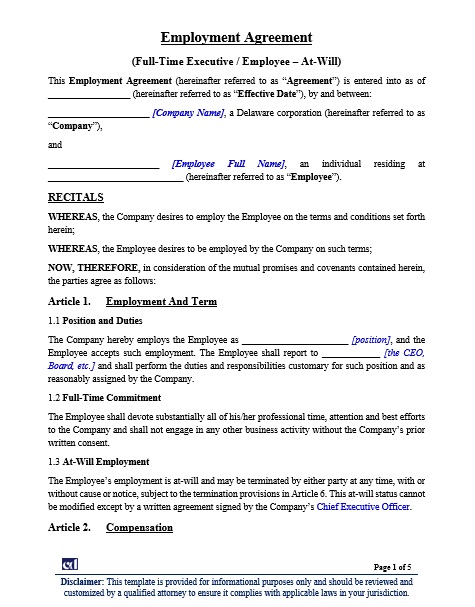
The attached template Employment Agreement follows a U.S. executive model with equity grants, restrictive covenants, and arbitration provisions under Delaware law.

Purpose and Function of an Employment Agreement
An executive employment contract establishes a binding framework between the company and a senior officer. Unlike standard employment letters, it integrates governance, fiduciary expectations, and ownership considerations.
First, it defines the executive’s position, reporting line, and scope of authority. Clarity here prevents future disputes over strategic control.
Second, it formalizes the at-will status while structuring termination consequences. This balance protects flexibility yet provides predictability.
Third, it aligns compensation with performance. Salary, discretionary bonus, and equity awards form a coordinated incentive system.
Finally, it protects corporate assets. Confidential information, intellectual property, and competitive positioning remain safeguarded even after termination.
In growth-stage and venture-backed companies, this agreement also reassures investors. Clear executive terms reduce governance risk and litigation exposure.
Core Components of an Employment Agreement
A properly drafted executive agreement contains interlocking provisions.
✅ Employment and Term.
The template confirms full-time commitment and at-will employment, subject to defined termination rights. This structure preserves managerial flexibility.
✅ Compensation Architecture.
The agreement separates fixed salary, discretionary bonus, and equity grants. Equity typically links to a separate incentive plan and vesting schedule. Double-trigger acceleration clauses often apply during change-of-control events.
✅ Intellectual Property Assignment.
The agreement includes a present assignment of future rights. This language prevents ownership gaps in inventions, code, strategies, or proprietary systems developed during employment.
✅ Confidentiality Protections.
Confidential information remains protected indefinitely. Return-of-materials clauses ensure control over data at exit.
✅ Restrictive Covenants.
Non-competition and non-solicitation clauses protect legitimate business interests. However, enforceability depends heavily on jurisdiction. Overbroad geographic scope or duration weakens enforceability.
✅ Termination Mechanics.
Cause, Good Reason, disability, and change-of-control events require precise drafting. Severance terms must coordinate with equity treatment and benefits continuation.
Each component works together. Weak drafting in one section can undermine the entire structure.
Practical Use and Application
This agreement is most relevant in:
- Venture-backed startups hiring C-level officers
- Private companies appointing senior management
- Growth-stage companies preparing for acquisition
- Public companies aligning executive incentives
For boards, the agreement sets risk boundaries. For executives, it defines economic upside and exit protection.
The inclusion of arbitration under commercial rules streamlines dispute resolution. Delaware governing law enhances predictability, particularly for corporations incorporated there.
Equity terms deserve special attention. Vesting schedules, forfeiture rules, and post-termination exercise windows directly affect executive wealth outcomes. Misalignment here often leads to disputes.
Similarly, severance language must coordinate with corporate policy and investor agreements. Inconsistent drafting creates liability exposure.
Common Challenges and Mistakes
Several recurring errors weaken executive employment agreements:
✅ Overreliance on boilerplate.
Generic non-compete clauses often fail under state law scrutiny.
✅ Incomplete IP assignment language.
Without a present assignment clause, ownership disputes may arise.
✅ Ambiguous “Cause” definitions.
Vague misconduct standards invite litigation.
✅ Inconsistent equity treatment.
Failure to harmonize with the equity plan leads to conflicts between documents.
✅ Ignoring local labor laws.
At-will language does not override mandatory employment protections in certain jurisdictions.
Executive agreements demand precision. They affect valuation, governance stability, and litigation risk.
Final Note
An Employment Agreement (Full-Time Executive) is both a governance tool and a financial alignment mechanism. When structured correctly, it protects corporate assets, clarifies authority, and secures leadership commitment. Poor drafting, however, creates exposure that surfaces during disputes or acquisition events. Professional review before execution is always advisable.
People also downloaded:
- Open-Ended Employment Agreement
- Freelance Services Agreement
- Retainer Agreement
- Influencer Marketing and Content Collaboration Agreement
- Independent Contractor Agreement (ICA)
“Looking for a different framework? Browse our full A-Z Index of Legal Templates“
Reference:
- Penn State Extension – Elements of an Employment Contract – This article outlines the core provisions, preliminary considerations, and advantages of formal employment contracts in clarifying the employer-employee relationship.
- SHRM – Take Care When Drafting Executive Employment Agreements – The article examines best practices and potential risks in drafting executive employment agreements to ensure clarity, reasonableness, and legal compliance.
- U.S. Department of Labor – Fact Sheet 13: Employment Relationship Under the Fair Labor Standards Act – This governmental guidance details the economic realities test used to establish whether an employment relationship exists under federal wage and hour law, directly relevant to employment agreements. …

has been added to your cart!
have been added to your cart!

