
Estimated reading time: 8 minutes
Understanding A Cryptocurrency Investment Agreement
In the rapidly evolving world of digital finance, cryptocurrency investments have become a cornerstone of innovation and economic growth. However, navigating this space within the European Union (EU) requires a deep understanding of regulatory frameworks to ensure compliance, security, and trust. A Cryptocurrency Investment Agreement serves as a vital tool for formalizing token-based funding in blockchain projects. This agreement not only outlines the terms between investors and investees but also aligns with stringent EU laws, including the Markets in Crypto-Assets Regulation (MiCA), the 5th Anti-Money Laundering Directive (AMLD5), and the General Data Protection Regulation (GDPR). These regulations collectively promote transparency, investor protection, and the prevention of illicit activities in the crypto ecosystem.
As of December 2025, with MiCA fully in effect since late 2024, the EU has established one of the most comprehensive regulatory environments for crypto-assets globally. This guide expands on the essentials of such agreements, exploring their structure, legal safeguards, benefits, and broader implications for Europe’s digital economy. Whether you’re an investor, entrepreneur, or legal professional, this detailed overview will help you grasp how these contracts bridge cutting-edge technology with robust legal standards.
The Regulatory Landscape for Cryptocurrency Investment in the EU
The EU’s approach to cryptocurrency regulation emphasizes harmonization across member states, reducing fragmentation and fostering a single market for digital assets. Let’s break down the key frameworks:
Markets in Crypto-Assets Regulation (MiCA)
Enacted as Regulation (EU) 2023/1114, MiCA provides uniform rules for crypto-assets not covered by existing financial laws, such as asset-referenced tokens (ARTs) and electronic money tokens (EMTs). It categorizes crypto-assets into three types: utility tokens, ARTs, and EMTs, each with tailored requirements.
- Issuer Obligations: Issuers must obtain authorization from national competent authorities (e.g., ESMA oversees coordination). They are required to publish a detailed whitepaper outlining the project’s risks, technology, and tokenomics. This document must be formatted per MiCA’s technical standards to ensure comparability and market surveillance.
- Investor Protection: MiCA mandates clear disclosures about risks, including volatility, cyber threats, and potential losses. Service providers, like trading platforms, must maintain order books and implement systems to prevent market abuse, such as insider trading or manipulation.
- Transparency and Supervision: Transactions are supervised to support financial stability, with guidelines on data standards for record-keeping.
MiCA’s focus on tailored regulation for crypto intermediaries recognizes the unique risks of blockchain technology while promoting innovation.
5th Anti-Money Laundering Directive (AMLD5)
AMLD5 extends AML/CTF rules to virtual asset service providers (VASPs), including crypto exchanges and wallet providers. It requires:
- Know Your Customer (KYC) Procedures: Entities must verify investor identities and funding sources to prevent money laundering or terrorist financing.
- Transaction Monitoring: Suspicious activities must be reported to authorities, aligning with FATF guidelines.
- Integration with MiCA: Crypto-asset service providers (CASPs) under MiCA are “obliged entities” under AMLD5, ensuring seamless compliance in investment agreements.
This directive mitigates risks like sanctions evasion, making formal agreements essential for traceable funding.
General Data Protection Regulation (GDPR)
GDPR governs the handling of personal data in crypto transactions, emphasizing consent, data minimization, and security.
- Data Protection in Agreements: Parties must outline how personal information (e.g., wallet addresses, KYC data) is processed, stored, and shared.
- Breach Notification: Any data incidents must be reported within 72 hours, with clauses for liability.
- Cross-Border Applicability: GDPR applies to EU residents, ensuring global investors comply when dealing with EU-based projects.
Together, these regulations create a robust ecosystem where cryptocurrency investment agreements act as enforceable contracts that uphold legal standards.
What is a Cryptocurrency Investment Agreement?
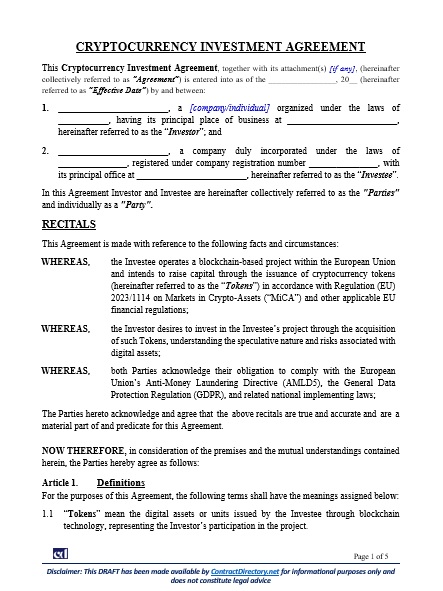
A Cryptocurrency Investment Agreement is a legally binding contract that facilitates token-based investments in blockchain ventures. Unlike traditional equity investments, it typically grants participation rights, such as access to project utilities or future revenues, rather than ownership stakes. In the EU, these agreements must be MiCA-compliant to legitimize funding rounds, such as initial coin offerings (ICOs) or security token offerings (STOs).
Main elements include:
- Investment Amount and Token Allocation: Specifies the fiat or crypto amount invested and the corresponding tokens issued.
- Delivery Mechanism: Details how tokens are transferred to the investor’s wallet.
- Rights and Obligations: Outlines governance, voting rights (if applicable), and exit strategies.
This formal structure contrasts with informal peer-to-peer crypto trades, which lack legal recourse and expose parties to risks like fraud or regulatory penalties.
Differences from Informal Crypto Transactions
Informal transactions, such as direct wallet-to-wallet transfers, offer speed but little protection. They often bypass KYC, increasing AML risks and potential fines under AMLD5 (up to €5 million or 10% of annual turnover).
In contrast, a formal agreement:
- Establishes a clear legal relationship, enforceable in EU courts.
- Provides operational security through defined terms, reducing disputes.
- Ensures cross-jurisdictional validity, as MiCA harmonizes rules across the 27 member states.
- Protects against volatility by including risk acknowledgments and contingencies.
For instance, if a project fails, investors in informal setups may lose everything without recourse, while agreement holders can pursue arbitration or claims based on warranties.
How to write a Cryptocurrency Investment Agreement
A comprehensive agreement typically spans multiple articles, drawing from standard templates while customizing for the project. Here’s an expanded look:
Recitals and Definitions
The preamble confirms EU compliance and defines terms like:
- Token: A digital asset representing rights in the project.
- Wallet Address: The blockchain identifier for token delivery.
- Investment Amount: The committed capital, often in EUR or stablecoins.
This section sets the foundation, ensuring all parties interpret terms uniformly.
Representations and Warranties
- Investee Guarantees: Affirms the whitepaper’s accuracy, project legitimacy, and MiCA authorization (if required).
- Investor Certifications: Confirms funds are from lawful sources, compliance with AMLD5, and understanding of risks like market fluctuations or regulatory changes.
These clauses provide legal certainty and grounds for termination if breached.
Investment Terms
Details the token issuance process, vesting schedules (e.g., lock-up periods to prevent dumps), and conversion mechanisms. Under MiCA, tokens must not mislead as financial instruments unless classified accordingly.
Confidentiality and Data Protection
Aligned with GDPR, this includes:
- Non-disclosure of proprietary info.
- Data processing agreements, specifying controllers and processors.
- Security measures against hacks, with liability for breaches.
KYC and AML Compliance
Mandatory under AMLD5, requiring identity verification, source-of-funds checks, and ongoing monitoring. Agreements often reference FATF standards for VASPs.
Dispute Resolution and Governing Law
- Force Majeure: Excuses performance for unforeseen events like cyberattacks or regulatory shifts.
- Arbitration: Prefers neutral venues like the London Court of International Arbitration (LCIA) for efficiency.
- Governing Law: Typically EU law or a member state’s (e.g., Luxembourg for crypto hubs).
These mechanisms facilitate cross-border resolutions without lengthy litigation.
Benefits and Legal Safeguards of a Cryptocurrency Investment Agreement
Such agreements offer:
- Investor Protection: Through disclosures and rights enforcement.
- Project Legitimacy: Attracts institutional funding by demonstrating compliance.
- Risk Mitigation: Covers cyber risks, market abuse, and data breaches.
- Traceability: Enhances audit trails for tax and regulatory purposes.
In practice, MiCA’s whitepaper requirements ensure investors are informed, reducing “rug pull” scams prevalent in unregulated spaces.
Challenges and Best Practices
Challenges include navigating MiCA’s authorization process (which can take months) and adapting to evolving rules. Best practices:
- Consult legal experts familiar with ESMA guidelines.
- Use standardized templates but tailor to project specifics.
- Conduct audits for smart contract security.
- Stay updated via EU resources like the European Commission’s digital finance page.
Significance for Europe’s Digital Economy
MiCA has positioned the EU as a leader in sustainable crypto regulation, fostering trust and innovation. Compliant agreements transform volatile funding into accountable pathways, supporting blockchain startups in sectors like DeFi, NFTs, and green tech. By 2025, with full MiCA implementation, these contracts are pivotal for scaling Europe’s digital economy, projected to contribute €1 trillion by 2030.
Future Outlook
As MiCA evolves, potentially incorporating DeFi and NFTs more explicitly, investment agreements will adapt. Global alignment with frameworks like the US’s potential crypto bills could further standardize practices.
Conclusion
A Cryptocurrency Investment Agreement under EU law is more than a contract; it’s a gateway to secure, regulated digital finance. By integrating MiCA, AMLD5, and GDPR, it ensures transparency, protection, and growth. For those entering this space, prioritizing compliance isn’t just legal, it’s strategic for long-term success. If drafting one, consider professional templates and consultations to optimize for your needs.
For further reference, you may review the following related templates:
- Cryptocurrency Mining Agreement
- Cryptocurrency Purchase and Sale
- Know Your Customer (KYC) and its Form
- KYC Application Form
And also a post in our Blog:
Glossary of Crypto Investment Terms
- SAFT (Simple Agreement for Future Tokens)
- A legal framework where investors fund a project now to receive functional tokens in the future.
- TGE (Token Generation Event)
- The specific technical event where a project’s tokens are first issued on the blockchain.
- KYC (Know Your Customer)
- The mandatory process of identifying and verifying the identity of the investor.
- AML (Anti-Money Laundering)
- Regulations and laws designed to prevent the movement of illegally obtained funds through crypto investments.
- USDT / USDC (Stablecoins)
- Digital assets pegged to the US Dollar, commonly used as the currency for funding token-based investments.
- Cliff Period
- A set duration after the TGE during which no tokens are released to the investor.
- Vesting
- The gradual release of tokens over time to ensure long-term stability and project commitment.
References:
- Elliptic – How crypto regulation changed in 2025: a global review – A 2025 analysis of major jurisdictional shifts in crypto policy, including the EU’s MiCA regime and US federal frameworks.
- Investopedia – Howey Test and Cryptocurrency: Understanding Investment Contracts – Explains how the SEC’s long-standing Howey Test determines if a specific crypto asset qualifies as a regulated security.
- Mondaq – Financial Litigation Trends: Dubai Court Breaks New Ground – Discusses a landmark 2025 court ruling ordering the physical return of cryptocurrency, impacting how investment agreements specify repayment terms. …

has been added to your cart!
have been added to your cart!

