Estimated reading time: 4 minutes

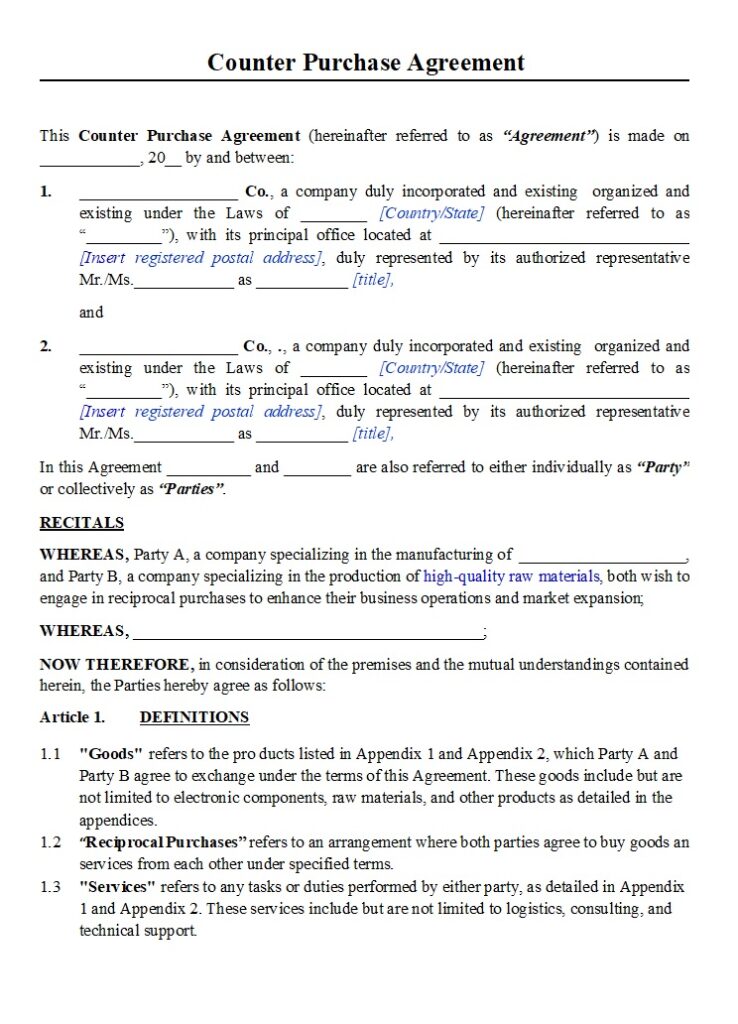
A Counter Purchase Agreement is a contractual arrangement in which both parties agree to buy goods or services from each other under separate but related contracts. It is a structured form of reciprocal trade that helps balance commercial interests, maintain long-term cooperation, and reduce financial risk. While traditionally used in international trade between countries, modern counter purchase arrangements are increasingly common among private corporations operating across industrial sectors.
Definition and Nature
In essence, a Counter Purchase Agreement involves two interlinked transactions: one party sells a product or service to another and, in return, commits to purchase a different product or service from that same party. Although each transaction stands as a separate contract, they are mutually dependent and often executed within the same commercial relationship.
The concept emerged during the late twentieth century as part of the broader category of countertrade mechanisms, which include barter, buyback, and offset agreements. Counter purchase offers more flexibility than direct barter because it allows each contract to be priced and settled independently, even though they remain economically related.
International Counter Purchase Agreements
In international commerce, a Counter Purchase Agreement typically involves two countries or companies based in different jurisdictions. The seller, often an exporter, agrees to buy specific goods produced by the importing country. This structure supports bilateral trade balance, promotes foreign exchange savings, and facilitates access to new markets—especially where conventional monetary payments may be limited by currency restrictions or trade sanctions.
For example, a European machinery supplier may sell industrial equipment to a South American manufacturer and agree to purchase agricultural products from the same country in return. Each side benefits: one gains access to advanced equipment, and the other secures an export market for its goods.
International counter purchase agreements are often governed by trade laws and regulations of the participating countries and may require government oversight or registration, particularly in strategic sectors such as energy, mining, or defense.
Domestic or Commercial Counter Purchase
In contemporary business practice, the counter purchase principle also appears in purely commercial transactions within the same country. In these cases, no national borders or state entities are involved. Two companies agree to buy each other’s products or services to strengthen their business partnership, secure supply chains, or optimize production costs.
For instance, a steel sheet manufacturer may supply materials to a pipe producer while simultaneously purchasing finished pipes from that same company for its own operations. Although this does not qualify as international countertrade, it still functions as a reciprocal purchase arrangement based on mutual benefit.
Such commercial counter purchase agreements help build stronger supplier relationships, improve liquidity, and reduce dependency on third parties. However, they still require clear documentation to define value equivalence, delivery schedules, and termination rights.
Structure and Key Clauses
A professional Counter Purchase Agreement includes two independent contracts, each detailing its own scope, price, payment method, and delivery terms. The agreement usually contains:
- A cross-reference clause identifying the reciprocal transaction;
- A commitment clause specifying the quantity, type, and time frame of counter purchases;
- Terms for quality assurance, inspection, and performance guarantees;
- A mechanism for dispute resolution applicable to both transactions.
- A clause confirming that each contract remains valid even if the other party faces delays or partial non-performance.
By structuring both contracts with transparent financial and logistical terms, parties ensure compliance and minimize risk.
Advantages and Considerations
Counter purchase arrangements offer several commercial and strategic advantages:
- They enable trade continuity when cash payments are limited or currency convertibility is restricted.
- They strengthen bilateral or corporate relationships through repeated and balanced transactions.
- They reduce exposure to foreign exchange volatility and banking delays.
- They allow companies to secure both supply and market access in a single negotiation framework.
However, they also present challenges. Valuing exchanged goods fairly can be complex, especially when market prices fluctuate. The administrative burden of managing dual contracts, customs documentation, and separate payment systems can also increase operational costs.
Legal and Regulatory Context
At the international level, World Trade Organization (WTO) regulations recognize counter-purchase and similar countertrade arrangements as valid commercial practices, provided they comply with non-discrimination and transparency principles. These agreements must not be used to circumvent tariffs, subsidies, or competition rules under global trade frameworks.
Domestically, contract law governs counter purchase arrangements just like any other commercial agreement. The key is to ensure that both contracts are clearly drafted, legally independent, and mutually enforceable. Transparency and documentation remain essential to prevent disputes or allegations of unfair trade practices.
Conclusion
A Counter Purchase Agreement serves as an adaptable tool that supports both international trade and domestic business cooperation. Whether between governments or private companies, it enables partners to exchange value in a balanced and transparent manner. By structuring the arrangement through clear documentation and mutual commitment, parties maintain flexibility, promote long-term trust, and align their commercial interests with evolving market realities.
Check out more pages of our website for related content:
References
- Investopedia – Countertrade: Definition and Key Mechanisms
- World Trade Organization (WTO) – Countertrade Practices and Trade Policy
- United Nations Conference on Trade and Development (UNCTAD) – Countertrade and Reciprocal Trade Arrangements
- Organisation for Economic Co-operation and Development (OECD) – Guidelines for International Trade and Investment

has been added to your cart!
have been added to your cart!

