Estimated reading time: 7 minutes
What Is a Copyright License Agreement
A Copyright License Agreement allows the creator (licensor) to control how others use their protected works while generating revenue. The licensor grants limited rights to the licensee without transferring ownership of the copyright. The licensee receives permission to reproduce, distribute, market, display, perform, or sell the works according to the specific terms outlined in the agreement. This arrangement provides legal protection for both parties and opens up commercial opportunities in industries such as publishing, music, software, film, and digital media.

Why Creators and Businesses Use Copyright License Agreements
Creators often turn to licensing when they want to expand the reach of their work beyond what they can achieve alone. Instead of selling the copyright outright (an assignment), licensing lets them retain full ownership while authorizing controlled use by others. Businesses benefit by accessing high-quality content, artwork, music, software code, or other protected materials without developing them from scratch. This mutually beneficial setup minimizes infringement risks and fosters collaborative innovation across creative and commercial sectors.
Types of Copyright Licenses: Exclusive vs. Non-Exclusive
Copyright licenses generally fall into two main categories: exclusive and non-exclusive. An exclusive license grants the licensee sole rights to use the work in the specified manner, meaning the licensor cannot grant similar rights to anyone else (and sometimes cannot use the work themselves in that way) during the term. This type is common for high-value deals, such as film adaptations or major merchandising rights, and often commands higher fees or royalties.
A non-exclusive license, by contrast, allows the licensor to grant the same rights to multiple licensees simultaneously while retaining their own usage rights. Non-exclusive licenses are more flexible and affordable, making them popular for stock photography, music synchronization, software distribution, or widespread content syndication. Choosing between exclusive and non-exclusive depends on the strategic goals, market potential, and desired level of control.
Core Components and Structure of a Copyright License Agreement
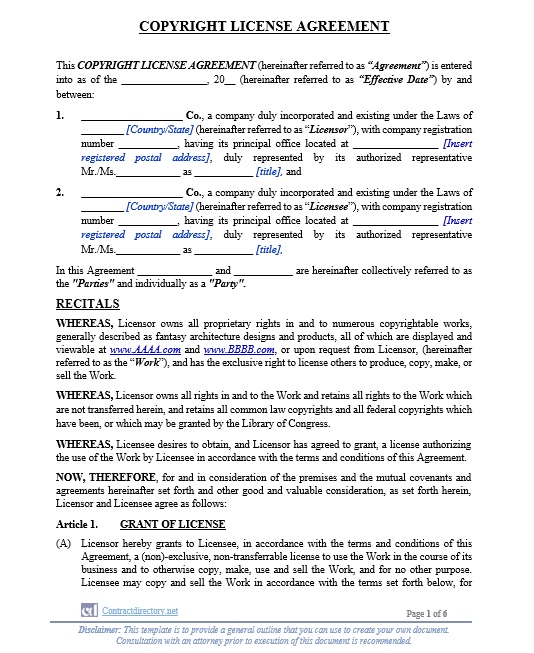
A well-drafted Copyright License Agreement includes several essential elements to ensure clarity and enforceability. It begins with identifying the parties (licensor and licensee) and provides a detailed description of the copyrighted work(s), such as books, songs, images, software, or audiovisual content.
The core grant of license clause specifies the scope of rights granted (e.g., reproduction, distribution, public performance, or creation of derivatives), whether the license is exclusive or non-exclusive, any territorial limits (e.g., worldwide or specific countries), and the duration (fixed term, perpetual, or renewable). Financial provisions detail royalties (often a percentage of sales), upfront fees, minimum guarantees, payment schedules, and audit rights for the licensor to verify reports. Additional clauses cover quality control standards, branding requirements, copyright notice obligations, restrictions on modifications or sublicensing, and termination conditions.
Rights, Obligations, and Limitations in Practice
Under a copyright license, the licensor always retains ultimate ownership of the copyright and moral rights (where applicable). The licensee gains only the defined usage rights and cannot claim ownership, register the work in their name, or make unauthorized changes without permission. Sublicensing typically requires the licensor’s express written consent.
The licensee must comply with obligations like including proper copyright notices, avoiding actions that harm the licensor’s reputation, and adhering to any approved quality or branding guidelines. In return, the licensor often provides warranties against third-party infringement claims and agrees to indemnify the licensee in certain scenarios. These balanced rights and limitations help prevent disputes and maintain the integrity of the original work.
Benefits of the Agreement
A copyright license agreement delivers significant advantages for both creators and licensees. Licensors can monetize their intellectual property through royalties, licensing fees, or other revenue streams, achieving wider distribution and market exposure without losing control. This creates passive or recurring income while preserving long-term value in the copyright.
For licensees, the agreement provides secure, legal access to valuable content that enhances products, marketing campaigns, or services, often at a fraction of the cost of creating similar material. Standardized clauses for dispute resolution (such as mediation or arbitration) further reduce litigation risks. Overall, copyright licensing promotes sustainable growth, encourages creative collaboration, and strengthens intellectual property protection in competitive markets.
When to Use the Agreement and Next Steps
Businesses and creators should consider a Copyright License Agreement whenever third-party use of protected material is involved, such as in publishing deals, software integrations, merchandise, advertising, or content syndication. To get started, consult legal professionals or use customizable templates as a foundation, then tailor the document to the specific work, rights, and commercial terms. A clear, comprehensive agreement not only safeguards interests but also builds trust and supports successful long-term partnerships.
The Global Framework: Understanding the Berne Convention
Adopted in 1886 in Berne, Switzerland, and now administered by the World Intellectual Property Organization (WIPO), the Berne Convention establishes essential minimum standards for copyright protection. It ensures automatic protection for literary and artistic works—without requiring formal registration—once a work is created and fixed in a tangible medium. Key principles include national treatment (works from member countries receive the same protection as domestic works in other member states), automatic copyright upon creation, and a minimum protection term (typically the life of the author plus 50 years, though many countries extend it to life plus 70 years).
As of February 2026, the Berne Convention has 182 contracting parties, encompassing nearly all UN member states plus entities like the Cook Islands, Holy See (Vatican), and Niue. This widespread adoption creates a robust global network where creators benefit from reciprocal protection, reducing piracy risks and encouraging international distribution of books, music, films, software, artwork, and other copyrighted materials.
Countries Outside the Berne Convention: Remaining Gaps in Global Copyright Harmony
Despite its near-universal reach, a handful of countries and territories have not joined the Berne Convention, creating potential challenges for cross-border copyright enforcement. These non-members do not automatically grant reciprocal protection to works from Berne countries, and their own works may lack automatic safeguards abroad (though bilateral agreements, domestic laws, or WTO/TRIPS obligations can sometimes provide partial coverage for WTO members).
Notable countries that remain outside the Berne Convention include Angola, Eritrea, Ethiopia, Iran, Iraq, Kosovo, Maldives, and Marshall Islands. In these jurisdictions, copyright protection often relies on local legislation, which may be limited or inconsistent, potentially leading to higher risks of unauthorized use, reduced incentives for creators, and complications in international licensing or litigation. Many creators from non-member states seek protection by first publishing in a Berne country or leveraging other treaties.
Why the Berne Convention Matters for Copyright License Agreements
In the context of a Copyright License Agreement, the Berne Convention’s framework enhances enforceability and value. Licensees in member countries can confidently use licensed works knowing they enjoy standardized protections, while licensors benefit from automatic international safeguards that prevent unauthorized exploitation in most global markets. For deals spanning non-Berne jurisdictions, parties often include specific clauses addressing local laws, indemnities, or alternative protections to mitigate risks. Overall, the convention’s dominance supports secure, predictable licensing practices that drive creative industries worldwide.
Check out some other pages of our website for related content:
- License Agreement
- Grant of License Agreement
- AI Software License Agreement
- Technology Transfer Agreement
References
- World Intellectual Property Organization – “Understanding Copyright Licensing” – This article explains how licensing structures work and how creators grant permission while retaining ownership.
- U.S. Copyright Office – “Copyright Licensing Overview” – Provides guidance on license types, permitted uses, rights granted, and legal implications for licensors and licensees.
- Harvard Law School – “Copyright and Licensing Basics” – Offers a practical outline of how licensing agreements function in commercial environments and why precise terms matter.
- World Intellectual Property Organization (WIPO) – Berne Convention for the Protection of Literary and Artistic Works – The Berne Convention, adopted in 1886 and administered by WIPO, is the leading international treaty that establishes minimum standards for copyright protection, including automatic protection without registration, national treatment for foreign works, and a minimum term of the author’s life plus 50 years (often extended), with 182 contracting parties as of 2026 ensuring broad reciprocal safeguards for literary and artistic works worldwide.
- Wikipedia – Berne Convention – The Berne Convention for the Protection of Literary and Artistic Works is a foundational international copyright treaty from 1886 that promotes automatic copyright upon creation, eliminates formalities like registration for protection in member countries, and provides national treatment, covering 181–182 parties (including most UN members plus entities like the Cook Islands, Holy See, and Niue) while a few nations such as Eritrea, Ethiopia, Iran, Iraq, and others remain non-members. …

has been added to your cart!
have been added to your cart!

