Estimated reading time: 3 minutes
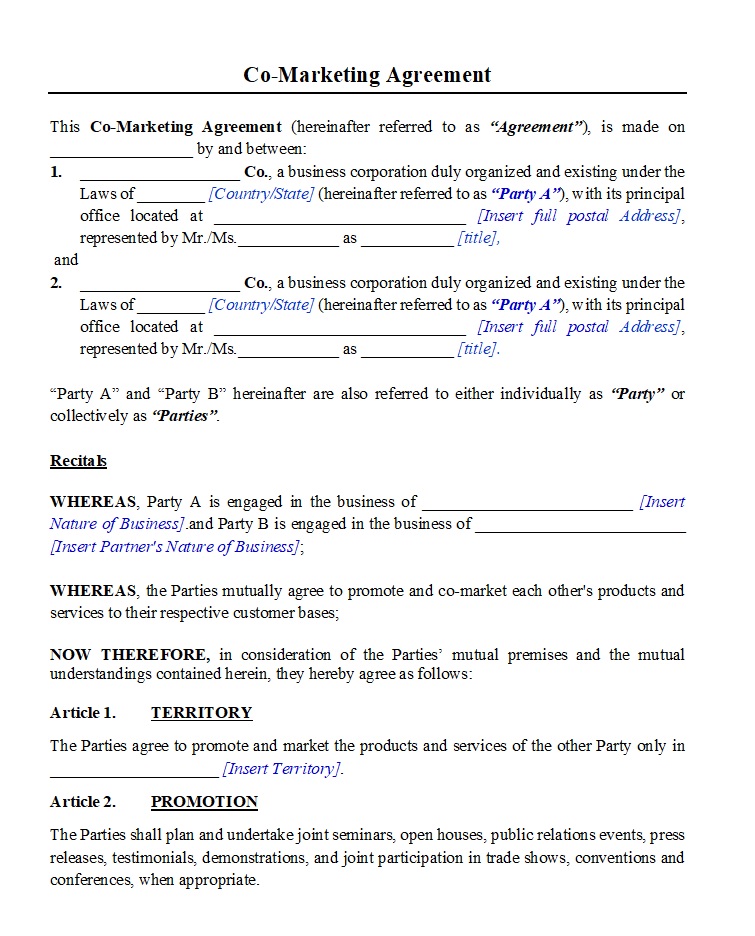
A Co-Marketing Agreement formalizes a collaborative relationship between two or more businesses that agree to jointly promote each other’s products or services. It provides a clear framework for cooperation, ensuring that both sides benefit from the shared exposure, resources, and market reach.
Scope and Territory of a Co-Marketing Agreement
These agreements define the territory where the co-marketing efforts will apply. The arrangement can be exclusive or non-exclusive, depending on the strategic goals of the parties involved. By specifying the territory, businesses avoid overlap and ensure clear boundaries in their promotional activities.

Responsibilities
A Co-Marketing Agreement sets out the roles of each party. Typical responsibilities include organising joint events, sharing leads, preparing presentations, and collaborating on advertising campaigns. Each party usually agrees to provide training to the other’s team to ensure accurate representation of products and services. Costs are generally borne by the party incurring them unless otherwise agreed.
Intellectual Property and Confidentiality
The use of trademarks, trade names, and promotional materials is often a central feature. Each party grants limited rights to use its branding while retaining full ownership. Confidentiality clauses ensure that sensitive business information shared during the partnership remains protected.
Payments and Revenue Sharing
Revenue generated through co-marketing efforts may be shared between the parties in accordance with pre-agreed percentages. Monthly or quarterly reporting ensures transparency, while payment provisions clarify entitlements. This mechanism incentivises both sides to contribute to the campaign’s success actively.
Termination and Dispute Resolution
A Co-Marketing Agreement also defines its duration and the conditions under which it may be terminated, such as default, insolvency, or breach. Disputes are often resolved through arbitration or mediation, helping the parties maintain a professional relationship even when conflicts arise.
Conclusion
A Co-Marketing Agreement is an effective tool for businesses that wish to expand their reach without bearing the full cost of marketing independently. It formalises collaboration, protects rights, and ensures fair sharing of responsibilities and benefits.
Check out more pages of our website for related content:
- Distribution Agreement
- Business Development Agreement (BDA)
- Marketing Agreement
- Digital Marketing Services Agreement
Access the Full Contract Directory Index
You can browse
the complete alphabetical list of all commercial, financial, and project-based contract templates by visiting our A–Z Contract Index.
References
- HubSpot – Getting Started With Co-Marketing – This guide provides an extensive overview of developing a co-marketing strategy, including choosing partners and measuring the success of joint lead-generation campaigns.
- Shopify – 15 Retail Brand Collaboration Examples (2025) – The article explores how distinct brands use co-branding and co-marketing to reach new audiences and create unique product offerings through strategic partnerships.
- Sprout Social – 29 Influencer Marketing Statistics for Your Social Strategy in 2025 – This reference details how B2B brands use collaborative influencer marketing to increase brand awareness, credibility, and trust through long-term partnerships…

has been added to your cart!
have been added to your cart!

