Estimated reading time: 4 minutes
A Co-Founders Agreement is the structural foundation of any serious Startup. Before investors enter, before revenue flows, and before valuation discussions begin, founders must define ownership, control, intellectual property, and exit mechanics. Without written clarity, misunderstandings quickly escalate into equity disputes or governance breakdowns.
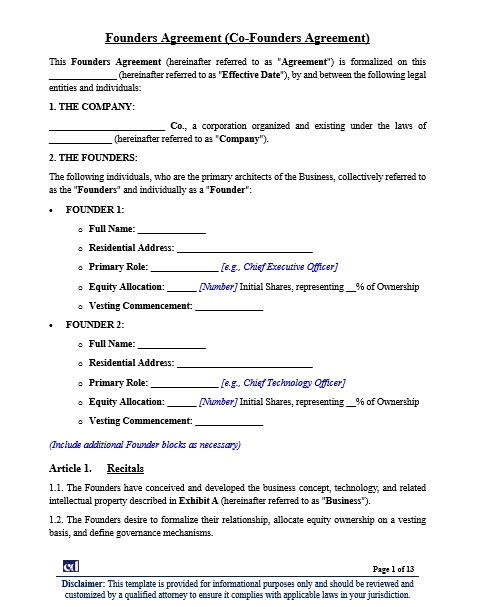
The attached template provides a venture-ready structure covering vesting, deadlock resolution, drag/tag rights, and IP warranties.

Purpose and Function of a Co-Founders Agreement
A Co-Founders Agreement formalizes the relationship between individuals who create and build a company together. It allocates equity on a vesting basis, defines roles, and establishes decision-making rules.
First, it clarifies ownership from day one. Equity splits without vesting create immediate risk.
Second, it assigns intellectual property to the company. Investors require clean IP ownership before funding.
Third, it sets governance mechanics. Voting thresholds and consent requirements reduce ambiguity.
Finally, it pre-defines exit procedures. Deadlock, departure, acquisition, and transfer events must follow clear rules.
In early-stage companies, this agreement functions as internal constitutional law. It protects both majority and minority founders.
Core Components
A robust Co-Founders Agreement integrates several interconnected mechanisms.
✅ Equity and Vesting Structure.
The template applies a four-year vesting schedule with a one-year cliff. Continued service drives vesting. This protects the company if a founder leaves early.
Double-trigger acceleration upon change of control balances founder protection with investor expectations.
✅ Good Leaver vs. Bad Leaver Framework.
Departure scenarios materially affect equity retention. A Good Leaver typically retains vested shares. A Bad Leaver risks repurchase of both vested and unvested shares at cost.
Clear definitions of Cause and Good Reason reduce litigation risk.
✅ Intellectual Property Assignment.
Each founder assigns pre-existing and future IP to the company. Warranties confirm lawful ownership and non-infringement. Indemnification clauses protect the company from third-party claims.
Without this section, financing often stalls.
✅ Deadlock Resolution (Shotgun Mechanism).
If mediation fails, a buy-sell trigger allows one founder to set a price per share. The receiving founder must either sell or purchase at that same price. This pricing symmetry discourages abuse.
Deadlock clauses preserve operational continuity.
✅ Drag-Along and Tag-Along Rights.
Drag-along provisions compel minority holders to sell during an approved exit. Tag-along rights protect minority founders when a majority sells to third parties.
These clauses align founders during acquisition negotiations.
✅ Founder Lock-Up and Transfer Restrictions.
Share transfer restrictions prevent premature dilution or unwanted third-party entry. IPO lock-ups align with underwriter standards.
Each component works together to create structural predictability.
Practical Use and Application of a Co-Founders Agreement
This agreement should be executed before or immediately upon incorporation. Verbal understandings are insufficient.
It is particularly critical when:
- Founders contribute unequal capital or IP
- Roles differ significantly
- Future fundraising is anticipated
- Jurisdiction imposes complex equity tax rules
The inclusion of 83(b) election language addresses tax exposure tied to restricted stock issuance. Failure to file timely elections can create severe tax consequences.
Similarly, milestone-based reverse vesting protects the company if a founder underperforms or departs before value creation.
Investors routinely review this agreement during due diligence. Incomplete repurchase rights or missing IP warranties weaken negotiating leverage.
Common Challenges and Mistakes
Founders frequently delay documentation. That delay creates avoidable risk.
✅ Equal equity without vesting.
This often results in inactive founders retaining significant ownership.
✅ No deadlock mechanism.
Equal voting power without resolution procedures can freeze operations.
✅ Ambiguous repurchase procedures.
Unclear timelines and payment terms trigger disputes.
✅ Overly aggressive non-compete clauses.
Excessive scope may render restrictions unenforceable.
✅ Ignoring tax mechanics.
Failure to address equity elections and withholding obligations creates financial exposure.
Strong drafting anticipates conflict before it happens.
Final Note
A Co-Founders Agreement transforms informal collaboration into a legally structured partnership within a corporate framework. It allocates risk, clarifies expectations, and protects long-term value. When executed early and drafted carefully, it prevents disputes that otherwise surface at financing or exit.
People also downloaded:
- Start-Up Agreement (SUA)
- Fundraising Agreement
- Funding Guarantee
- Personal Loan Agreement
- Convertible Promissory Note
- Convertible Loan Agreement
“Looking for a different framework? Browse our full A-Z Index of Legal Templates“
Reference:
- Harvard Business School – Founders’ Agreements – Background Note – This background note outlines the four core elements of founders’ agreements — roles, rights, commitments, and contingencies — and provides a practical checklist to help co-founders document decisions and reduce early-stage conflict.
- Northwestern University Farley Center – A Better Approach to Co-Founder Equity Splits – The article introduces the Slicing Pie model as a dynamic, contribution-based method for allocating equity among co-founders instead of fixed initial splits, with guidance on vesting and control preservation.
- University of Arizona Tech Launch – Week 5: Key Agreements – This university module explains the Founders Agreement as an early-stage “startup constitution” that addresses ownership, responsibilities, decision-making processes, and operational rules to align co-founders from the outset.

has been added to your cart!
have been added to your cart!

