Estimated reading time: 4 minutes
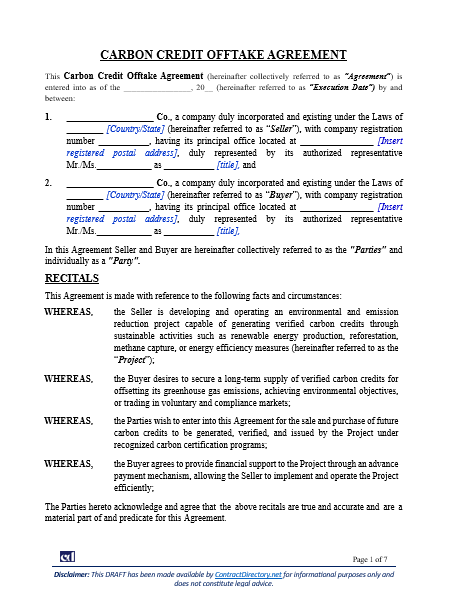
A Carbon Credit Offtake Agreement defines a long-term contractual arrangement in which a project developer agrees to sell, and a buyer agrees to purchase, future carbon credits that will be generated and verified over time. Unlike a simple purchase agreement, which transfers existing credits, the offtake structure finances the early stages of environmental projects by guaranteeing a market for the credits once issued.
Through this mechanism, developers obtain predictable revenue streams to fund project implementation, while buyers secure future carbon offsets to meet environmental and compliance goals at predetermined prices. This agreement is essential in bridging environmental ambition with financial viability.
✅ Structure and Commercial Purpose of a Carbon Credit Offtake Agreement
The offtake framework transforms sustainability commitments into tangible commercial transactions. It typically includes definitions, price schedules, verification processes, and delivery milestones aligned with recognized carbon standards such as the Verified Carbon Standard (VCS) or the Gold Standard.
The buyer often provides a partial advance payment to support project development, functioning as quasi-financing without creating a loan or debt relationship. As a result, the buyer obtains long-term access to verified credits at a fixed or index-linked rate, hedging against future market volatility. The seller, meanwhile, gains liquidity to build and operate emission-reduction projects such as reforestation, bioenergy, or waste-to-energy facilities.
✅ Legal and Compliance Foundations
This agreement ensures that every future credit delivered is verifiable, unique, and compliant with frameworks under the Kyoto Protocol and the Paris Agreement. It includes clauses for environmental and social safeguards, change in law, confidentiality, force majeure, and arbitration under the ICC Rules. These provisions protect both parties from regulatory changes, project delays, or unforeseen global events. Verification and monitoring obligations follow ISO 14064-3 standards, ensuring traceability and integrity in the generation of credits. The combination of legal certainty and environmental accountability makes the Carbon Credit Offtake Agreement a cornerstone of modern green finance.
✅ Risk Allocation and Market Impact
Risk management is central to offtake design. The agreement distributes commercial, operational, and regulatory risks between buyer and seller through detailed warranties, indemnities, and insurance obligations. It also allows for price adjustment mechanisms linked to carbon market benchmarks, ensuring fairness over multi-year delivery periods.
As the global carbon market expands, offtake contracts are increasingly used by corporations, funds, and governments. The Purpose is to invest in verified emission-reduction initiatives, signaling a shift from voluntary action to structured climate financing. In practice, the Carbon Credit Offtake Agreement becomes both a sustainability instrument and an investment vehicle. It aligns financial markets with the objectives of climate policy.
✅ Conclusion
The Carbon Credit Offtake Agreement stands at the intersection of environmental law, finance, and sustainable development. It enables investors to support the creation of low-carbon infrastructure while giving corporations measurable pathways toward carbon neutrality. By integrating project financing with verified climate performance, it transforms emission reduction into a tradable and accountable asset. This agreement exemplifies how environmental and commercial objectives can coexist under a clear, enforceable legal framework.
Other related Agreement:
- Carbon Credit Purchase Agreement
- Carbon Credit: The Currency of a Greener Planet (Post)
- Green Finance: How Sustainability Is Redefining Global Project (Post)
- Green Loan Agreement
Glossary of Carbon Credit Offtake Terms
- VCM (Voluntary Carbon Market)
- The decentralized market where private entities voluntarily buy and sell carbon credits to offset their emissions, separate from government-mandated compliance markets.
- VER (Verified Emission Reduction)
- A unit representing one metric ton of CO2 equivalent that has been prevented from entering the atmosphere, verified by independent standards like Verra or Gold Standard.
- Forward Action Credits
- A mechanism in offtake agreements where the buyer pays today for credits that will be generated and delivered in future years, providing crucial early-stage project funding.
- Additionality
- A core legal requirement proving that the CO2 reduction would NOT have occurred without the financial incentive provided by the carbon credit sale.
- Vintage Year
- The specific year in which the carbon emission reduction actually took place, which often dictates the market price of the credit in the offtake agreement.
References
- United Nations Framework Convention on Climate Change (UNFCCC) –The Paris Agreement
- United Nations Framework Convention on Climate Change (UNFCCC) – Kyoto Protocol to the United Nations Framework Convention on Climate Change
- Verra –Verified Carbon Standard (VCS) Program Overview …

has been added to your cart!
have been added to your cart!

