Estimated reading time: 4 minutes
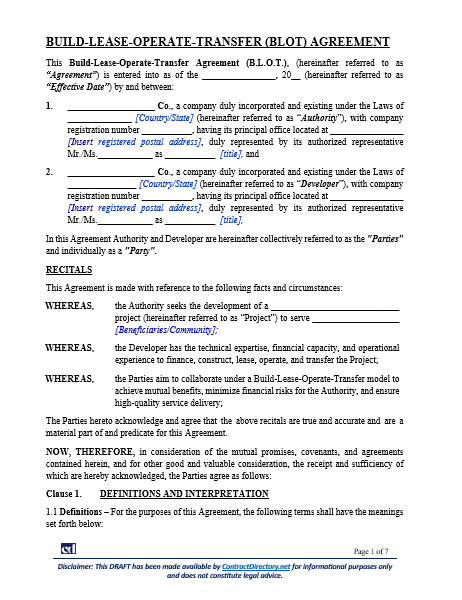
A Build-Lease-Operate-Transfer Agreement (B.L.O.T) is a project delivery model where a private party builds a facility, leases it to the project owner or authority, operates it for a specified term, and finally transfers it back at the end of the concession period. This structure is widely recognized as a hybrid of B.O.T. and B.O.O.T. models and is particularly valuable for cash-strapped owners who cannot fund construction upfront.

Purpose and Financing Role of a B.L.O.T.
Build-Lease-Operate-Transfer Agreements are often used as a financing solution when the project owner has no available budget to build the project. The private developer finances construction, assumes construction risk, and earns revenue through lease payments and operational income. These payments allow the developer to recover its investment while ensuring the facility remains functional and properly maintained.
Key Phases
- Build: The developer designs and constructs the project according to agreed specifications.
- Lease: The completed facility is leased to the owner or an anchor tenant, generating predictable lease revenue.
- Operate: The developer manages and operates the facility, ensuring service quality and compliance with performance standards.
- Transfer: At the end of the lease/concession period, the project is transferred to the owner in good working order, free of liens.
Where B.L.O.T. is Used
BLOT Agreements are commonly seen in:
- Real Estate & Commercial Infrastructure – airports, ports, and logistics parks, where public authorities prefer leasing instead of immediate purchase.
- Energy & Utilities – power plants, water treatment facilities, where lease fees and operational revenues fund repayment.
- Industrial Facilities – manufacturing hubs or warehouses developed under long-term lease-to-transfer arrangements.
Advantages of B.L.O.T.
- Ownership Assurance: Guarantees eventual transfer of the asset to the owner.
- Financing Flexibility: Allows owners to defer large capital expenditures.
- Risk Transfer: Shifts construction and operational risk to the developer.
- Predictable Cash Flow: Lease payments create a stable income stream for investors.
BLOT Model in Infrastructure Development
A B.L.O.T model extends the B.L.T. approach by adding an operational phase before ownership transfer. In this structure, the private company leases the asset to the end user while also managing daily operations and maintenance. As a result, the company ensures professional management throughout the lease period and reduces inefficiencies before the transition occurs.
Moreover, transport hubs, energy facilities, and public service projects often adopt B.L.O.T agreements to balance financial risks with operational stability. Because of the leasing phase, the recipient can integrate the asset into long-term plans without facing early-stage operational challenges. In addition, a gradual transition allows stakeholders to assess performance and refine processes before ownership changes hands.
Note: You may also check out other models such as:
- Build-Operate-Transfer Agreement (B.O.T)
- Build-Own-Operate Agreement (B.O.O)
- Build-Own-Operate-Transfer Agreement (B.O.O.T)
These agreements share similarities with B.L.O.T Agreement but differ in ownership and transfer structures. These alternatives offer governments and private investors additional flexibility in structuring infrastructure partnerships.
Glossary of Key BLT Terms
- Leaseback Arrangement
- A contractual setup where the private entity builds the facility and then leases it back to the government or a public authority for a predetermined period in exchange for regular lease payments.
- Financial Lease vs. Operating Lease
- The distinction in how the asset is treated on the balance sheet; in BLT, the lease is typically structured to ensure the private partner recovers its full capital expenditure (CAPEX) plus interest.
- Transfer of Title
- The legal process at the end of the lease term where the ownership of the infrastructure is formally transferred from the private entity to the public authority, often for a nominal fee.
- Fixed Lease Payments
- Pre-agreed rental amounts paid by the public sector, which reduce the “demand risk” for the private partner compared to user-pay models like toll roads.
- Maintenance Obligations
- The specific duties of the private operator to keep the asset in optimal condition during the lease term to ensure it meets handback standards at the time of transfer.
References:
- Lexology – The Build-Lease-Transfer Model: First Health Campuses, What´s Next? – This article explores the application of the Build-Lease-Transfer (BLT) model in developing health campuses, detailing key project agreements and lifecycle considerations.
- SuperMoney – The Mechanics of Build-Operate-Transfer (BOT) Contracts – The entry explains the structure of BOT contracts while highlighting variants such as Build-Lease-Transfer (BLT) where the government leases the project before eventual transfer.
- Faster Capital – Build Operate Transfer: BOT: Comparing BOT and BLT Models – This piece compares the Build-Operate-Transfer (BOT) and Build-Lease-Transfer (BLT) models, discussing their advantages for different infrastructure project scenarios. …

has been added to your cart!
have been added to your cart!

