Estimated reading time: 4 minutes
A Bankruptcy Announcement formally informs creditors, courts, and the market that insolvency proceedings have commenced. It signals legal protection, activates creditor procedures, and establishes transparency. This article explains its purpose, structure, practical function, and common drafting risks in commercial practice.

Purpose and Function of a A Bankruptcy Announcement
A Bankruptcy Announcement serves as a public declaration of insolvency. It confirms that a court has opened proceedings under applicable bankruptcy law. In many jurisdictions, publication is mandatory.
The announcement protects legal certainty. First, it notifies creditors of deadlines. Second, it triggers statutory moratorium rules. Third, it clarifies who controls the debtor’s assets.
For example, in the United States under Chapter 11, the filing immediately activates an automatic stay. In the United Kingdom, insolvency notices appear through official channels linked to The Gazette. Each system requires formal notification to preserve fairness among creditors.
Therefore, the Bankruptcy Announcement operates as a legal checkpoint. Without it, enforcement chaos could follow.
Core Components
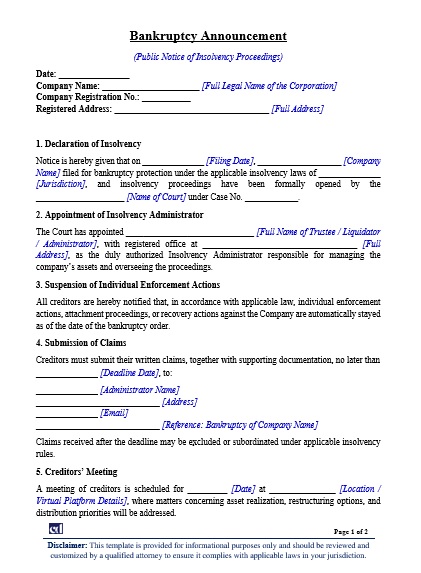
A properly drafted Bankruptcy Announcement contains specific elements. Courts reject vague or incomplete notices. It must identify the debtor precisely. This includes full legal name, registration number, and registered office. Accuracy prevents disputes over identity.
It must reference the court order. The case number, filing date, and jurisdiction establish procedural legitimacy. It must confirm the appointment of the insolvency officeholder. In liquidation, a liquidator is named. In restructuring, an administrator or trustee may act.
It must specify the claim submission deadline. Creditors require clear instructions on how and where to lodge proof of debt. It often states that enforcement actions are suspended. This reinforces the moratorium effect.
In cross-border cases, notice may align with frameworks such as UNCITRAL Model Law on Cross-Border Insolvency, particularly where foreign recognition is required. Clarity and precision matter. Ambiguity weakens enforceability.
Practical Use and Application
A Bankruptcy Announcement appears in several contexts.
- First, companies issue it after voluntary filing. Directors use it to demonstrate transparency and limit liability exposure.
- Second, courts publish it following compulsory winding-up petitions.
- Third, restructuring cases require market disclosure when bonds or listed securities are involved.
Financial institutions monitor such announcements closely. Regulatory expectations from bodies like Financial Conduct Authority may require timely disclosure where securities are traded.
Additionally, trade counterparties rely on the notice to suspend performance or invoke insolvency clauses. Supply chains often react immediately.
For international businesses, publication helps prevent asset dissipation across borders. It supports recognition proceedings in other jurisdictions. Thus, the Bankruptcy Announcement functions as both legal notice and commercial signal.
Common Challenges and Mistakes in Bankruptcy Announcement
Many companies underestimate drafting risks. One common mistake involves incorrect corporate details. Even minor discrepancies can invalidate service. Another problem concerns unclear claim procedures. If deadlines or submission addresses remain vague, disputes arise later.
Some announcements omit reference to the moratorium. This omission creates confusion among aggressive creditors. Cross-border insolvency adds further complexity. Failure to coordinate publication timing across jurisdictions weakens protection.
Directors sometimes delay publication. That delay increases personal exposure for wrongful trading or misrepresentation. Therefore, insolvency professionals should align the announcement with court orders and statutory language. Precision protects all stakeholders.
Final Note
A Bankruptcy Announcement marks a turning point in corporate life. It establishes procedural order, protects creditor equality, and frames the next legal stage. Although short in format, it carries significant legal weight and must reflect strict statutory compliance.
People also downloaded:
“Looking for a different framework? Browse our full A-Z Index of Legal Templates“
Reference:
- United States Courts – Notice of Chapter 11 Bankruptcy Case – This official form serves as a standard public notice template for informing creditors about a Chapter 11 bankruptcy filing, including case details, automatic stay, meeting of creditors, and deadlines.
- United States Courts – Bankruptcy Forms – This comprehensive directory provides official bankruptcy forms and notices, including creditor notification templates used in public announcements of insolvency proceedings across U.S. jurisdictions.
- The Gazette – Place an insolvency notice – This resource explains how to publish mandatory public notices for insolvency proceedings, such as petitions to wind up companies, serving as a key channel for bankruptcy announcements in the UK. …

has been added to your cart!
have been added to your cart!

