Estimated reading time: 3 minutes
Annual maintenance, often formalized through an Annual Maintenance Agreement, forms a structured cycle of recurring activities that keep assets stable, predictable, and ready for continuous use. Organizations rely on this disciplined approach because it prevents unexpected failures and supports long-term asset performance.
As these activities occur at planned intervals, annual maintenance creates continuity and reduces operational disruptions. Moreover, it helps companies manage performance proactively rather than reactively, which shifts costs from emergency repair toward controlled and scheduled upkeep.
✔ The Role of the Annual Maintenance Agreement in Structuring Service Delivery
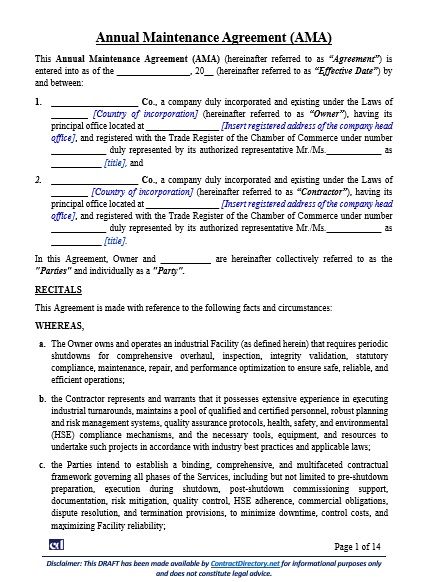
An Annual Maintenance Agreement establishes the framework for delivering and monitoring each maintenance cycle. It defines the scope of work, expected service frequency, reporting duties, and performance requirements.
Through documented procedures and clear quality benchmarks, the Agreement turns fragmented tasks into an organized and enforceable service. It also guides how issues should be resolved, how corrective actions start, and how performance will be measured throughout the term. Consequently, both parties gain transparency and a shared understanding of service expectations.
✔ Legal, Operational, and Risk-Control Functions of the Annual Maintenance Agreement
The Annual Maintenance Agreement creates legal clarity by translating technical expectations into defined commitments. It sets liability limits, identifies warranty duties, and protects confidential information shared during maintenance. In addition, it outlines dispute-resolution methods and establishes criteria for approval of variations or contract changes.
Through defined service levels, response times, record-keeping rules, and compliance requirements, the Agreement ensures consistent execution. As a result, organizations gain higher reliability, reduced operational risk, and a stable framework for preserving asset integrity.
✔ Purpose and Function of the Annual Maintenance Agreement
An Annual Maintenance Agreement provides the structure that governs recurring maintenance services and their required outcomes. It replaces informal practices with a measurable and documented set of obligations. Because the Agreement defines clear service levels and schedules, it enables predictable execution across each maintenance cycle. It also helps the Owner anticipate workload, manage risks, and maintain operational readiness through steady oversight rather than crisis-driven decision-making.
✔ Contractual Structure, Obligations, and Performance Requirements
The Annual Maintenance Agreement outlines the Contractor’s responsibilities, the delivery plan, and the standards that guide each phase of maintenance. It specifies documentation rules, corrective-action steps, and reporting requirements in a detailed and systematic manner. By setting response times, operator qualifications, and compliance expectations, the Agreement supports disciplined service delivery.
Therefore, the Owner can measure performance against defined commitments rather than subjective impressions. This approach strengthens accountability and reduces operational uncertainty.
✔ Legal Protections, Risk Allocation, and Contract Management
The Annual Maintenance Agreement also protects both parties through defined legal obligations. It establishes warranty conditions, confidentiality rules, and limitations on liability. Moreover, it sets out how disputes will be resolved and under which circumstances termination may occur.
By embedding documentation requirements, proper record management, and regulatory compliance, the Agreement promotes continuity across maintenance cycles. Consequently, the Owner benefits from a predictable contract environment that supports asset stability and reduces exposure to operational risk.
✔ Operational Importance of Clear Contract Governance
A well-constructed Annual Maintenance Agreement ensures that recurring maintenance does not become fragmented, inconsistent, or dependent on informal practices. It provides a governance framework that aligns technical, operational, and legal expectations within a single document, enabling both parties to work with precision and accountability.
Since maintenance activities often involve access to sensitive operational systems, the Agreement safeguards the Owner’s interests through structured oversight and enforceable service requirements.
Check out other template agreements for related content:
Access the Full Contract Directory Index
You can browse the complete alphabetical list of all commercial, financial, and project-based contract templates by visiting our A–Z Contract Index.
Reference:
- ISA – Industrial Maintenance Best Practices
- MapCon – The Crucial Role of Annual Maintenance Contracts in Modern Asset Management

has been added to your cart!
have been added to your cart!

