Estimated reading time: 3 minutes
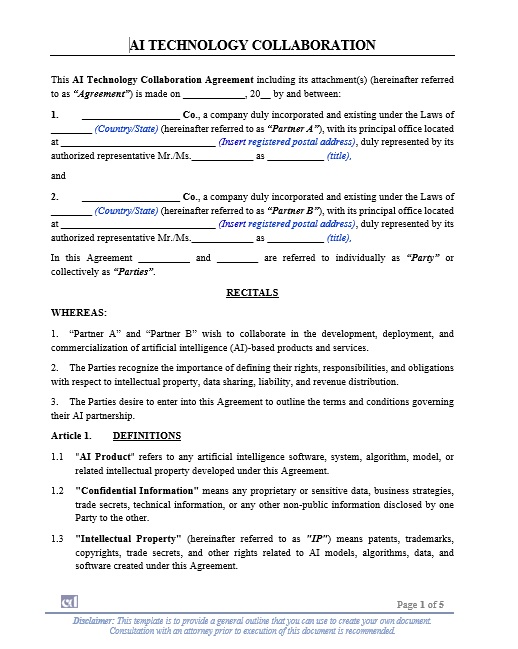
Artificial Intelligence (AI) transforms industries, drives innovation, and enhances business efficiency. Companies and research institutions must collaborate effectively to harness AI’s full potential. A well-structured AI Technology Collaboration Agreement ensures that all parties involved understand their roles, responsibilities, and rights in AI development and deployment.

Main Elements of AI Technology Collaboration Agreement
An AI collaboration agreement must outline each party’s contributions, such as research, data, algorithms, and computing resources. It should specify intellectual property (IP) ownership, licensing rights, and revenue-sharing mechanisms. Clarity on data usage policies is also essential to comply with data protection regulations.
According to Deloitte, over 60% of AI Technology Collaborations face challenges due to unclear data-sharing policies. A well-defined agreement mitigates risks and streamlines AI co-development efforts.
Why AI Collaborations Require Legal Clarity
AI partnerships often involve multiple organizations, including tech firms, academic institutions, and startups. Without a structured agreement, conflicts over data ownership, IP rights, and commercialization strategies can arise. Legal clarity ensures smooth collaboration and protects all stakeholders.
A 2023 Stanford AI Index report found that 90% of AI breakthroughs involve cross-industry collaboration. However, without legal safeguards, contributors may struggle to claim their fair share of the innovation.
Effective Commercialization in AI Partnerships
Bringing AI technologies to the market requires a robust strategy. The agreement should define licensing terms, profit distribution, and responsibilities for marketing and customer support. It must also ensure compliance with AI ethics and regulatory requirements.
A McKinsey survey found that businesses with well-defined AI collaboration agreements are 35% more successful in commercializing AI solutions than those without one. This highlights the importance of structured legal frameworks in AI commercialization.
Ensuring Long-Term Success in AI Collaborations
Successful AI partnerships rely on transparent governance models and continuous updates to agreements. As AI regulations evolve, contracts should be revised to reflect changes in compliance and industry standards. Regular communication and conflict resolution mechanisms must also be in place.
Conclusion: The Importance of AI Collaboration Agreements
The AI industry is expected to be worth $1.8 trillion by 2030, according to Statista. With AI collaboration becoming a key driver of innovation, organizations must establish strong legal frameworks. A well-drafted AI Technology Collaboration Agreement safeguards intellectual property, defines financial structures, and minimizes conflicts. As AI continues to evolve, companies that secure clear agreements will have a competitive edge in the global AI ecosystem.
Check out more pages of our website for related content:
- AI Product Development Agreement
- AI Service Agreement
- AI Development & Training Service Agreement
- Software as a Service (SaaS) Agreement
- AI Data-Sharing Agreement for Open AI Model Development
Access the Full Contract Directory Index
You can browse the complete alphabetical list of all commercial, financial, and project-based contract templates by visiting our A–Z Contract Index.
References
- Microsoft Azure – Azure AI: Drive Innovation Through Intelligent Cloud Solutions – This article details the convergence of cloud computing and AI services, explaining how businesses use pre-built cognitive models and MLOps to accelerate the development of custom machine learning applications.
- AWS (Amazon Web Services) – Build your AI career path with AWS’s new certification and hands-on learning experiences – This resource highlights the shift toward “agentic AI” and specialized training, outlining new 2025–2026 certification paths that help developers master foundation models and responsible AI deployment.
- Deloitte – Learn artificial intelligence at the Deloitte AI Academy – This page describes an end-to-end training ecosystem designed for organizations, focusing on bridging the technical skills gap in data engineering, neural networks, and ethical AI frameworks. …

has been added to your cart!
have been added to your cart!

