Estimated reading time: 3 minutes
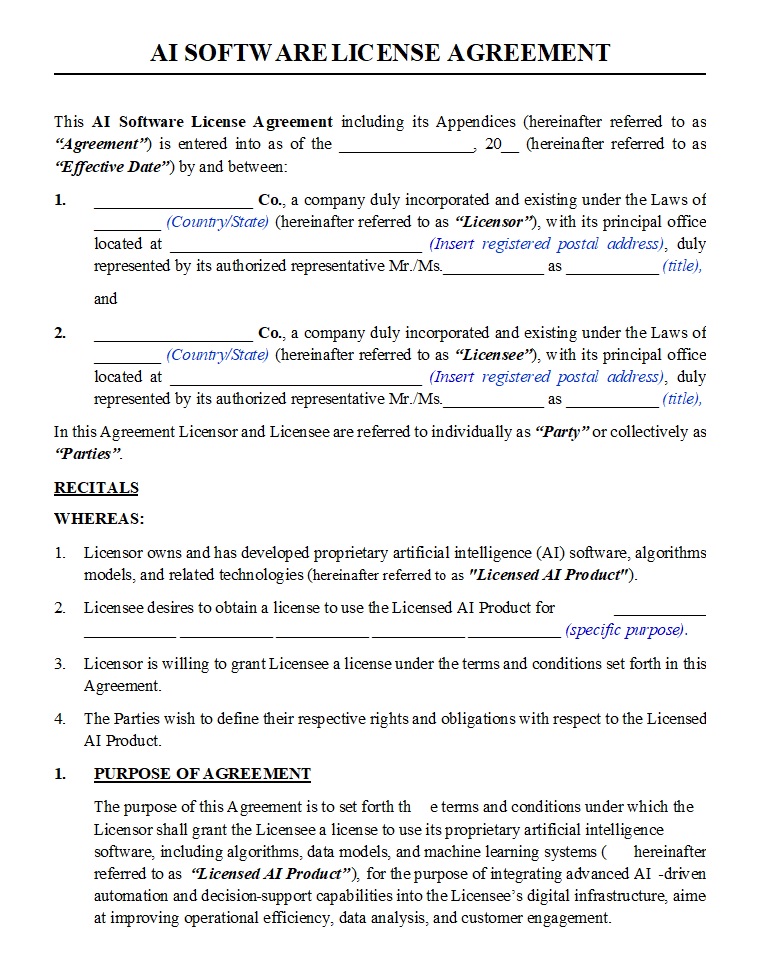
Businesses rely on advanced software to stay competitive. One critical tool is the AI Software License Agreement. It sets legal boundaries for AI use. This agreement ensures responsible use and clearly defines rights and limitations. In today’s digital world, using AI without legal clarity invites risk. Therefore, a clear license agreement protects both parties involved.

Why Businesses Need an AI Software License Agreement
Companies must control how their AI assets are used. An AI Software License Agreement limits unauthorized access or distribution. For instance, it prevents clients from copying, modifying, or reselling the software. Furthermore, it outlines payment terms, usage scope, and legal consequences. Without it, AI vendors lose control of their intellectual property. Licensees also risk using software outside the allowed terms. This can result in serious legal and financial penalties.
Common Use Cases in the AI Industry
Startups and enterprises use these agreements in various ways. Developers may license AI models for integration into customer applications. Alternatively, companies may grant limited access for research or internal use. These agreements define whether the use is commercial, internal, or research-based. Additionally, they may include ethical usage limitations. For example, the license may restrict military or discriminatory uses. These terms avoid misuse and ensure legal compliance.
The Importance of Customizing Each Agreement
Each AI solution has unique requirements. Hence, using a generic license agreement is risky. Instead, tailor the deal to fit your project and jurisdiction. Include clauses on data handling, privacy laws, and termination rules. Also, clarify ownership of AI-generated outputs. Clear clauses reduce conflicts and protect business interests. Always review terms with legal experts to avoid loopholes. In short, clarity in licensing builds trust and compliance.
Check out more pages of our website for related content:
- AI Service Agreement
- Software as a Service (SaaS) Agreement
- AI Product Development Agreement
- AI Technology Collaboration Agreement
Access the Full Contract Directory Index
You can browse the complete alphabetical list of all commercial, financial, and project-based contract templates by visiting our A–Z Contract Index.
Glossary of Key AI Licensing Terms
- Model Weights
- The numerical parameters that a neural network learns during the training process, which essentially contain the “intelligence” of the AI.
- Inference Data
- The real-world data (inputs) provided by the Licensee to the AI model to generate a specific output or prediction.
- Derivative Work
- Any translation, adaptation, or modification of the original AI model or its source code that creates a new copyrighted work.
- RLHF (Reinforcement Learning from Human Feedback)
- A training method that uses human guidance to fine-tune AI behavior, often a point of contention regarding Intellectual Property ownership.
References:
- Stanford University (HAI) – The AI Index Report 2025: Technical Performance and Policy – This provides the necessary data on AI reliability and performance metrics, which is crucial for defining “Performance Warranties” in your contracts.
- European Commission – The AI Act: Finalized Regulatory Framework – Since your contract mentions compliance, linking to the official AI Act portal proves to the customer that your template is up-to-date with 2025/2026 regulations…

has been added to your cart!
have been added to your cart!

