Estimated reading time: 3 minutes
Purpose of AI Data-Sharing Agreement
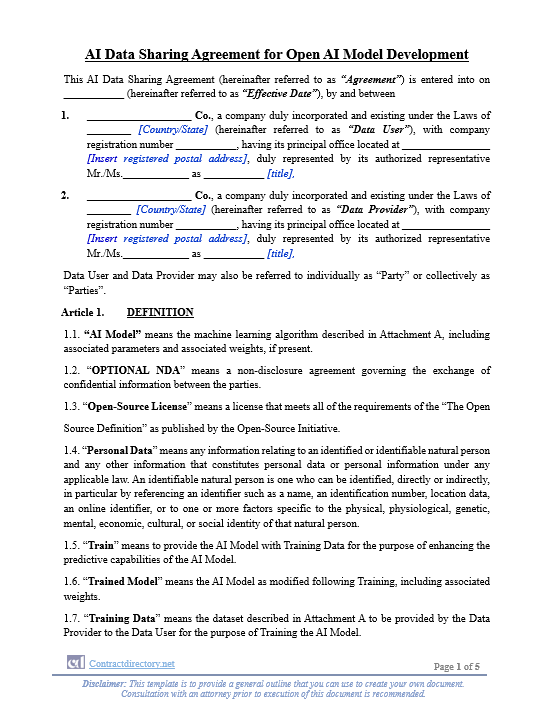
An AI Data-sharing Agreement outlines the secure sharing of data between partners. It ensures clarity and trust. It sets data scope, usage boundaries, and security protocols. Also, it establishes liability and breach actions.
Moreover, it protects privacy and intellectual property. Therefore, both parties commit to ethical use. In addition, regular review ensures ongoing compliance. The Agreement serves as a clear foundation. Similarly, the AI data-sharing agreement reinforces partner accountability and transparency.

Structure of the Agreement
The Agreement is structured in a clear and logical sequence to define the legal, operational, and technical framework governing data sharing and model development. It begins with detailed Recitals, outlining the intent of the Parties to collaborate in data contribution, processing, and AI model enhancement.
The subsequent Articles address specific domains, including definitions, data licensing, confidentiality, intellectual property ownership, and model output rights. Further sections cover compliance with data-protection laws, audit procedures, indemnity, liability limitations, and dispute-resolution mechanisms. The final provisions define the Agreement’s duration, termination procedures, governing law, and notices.
This structured composition ensures that each phase of data exchange and model use is governed by explicit obligations, thereby safeguarding proprietary information while promoting transparent and ethical AI development.
Benefits of Establishing the Agreement
Such an Agreement facilitates confident collaboration. It reduces legal uncertainty and safeguards sensitive information. It boosts stakeholder trust and reputational strength. It aligns data use with ethical AI values.
As a result, development proceeds faster and more securely. Finally, both parties gain clarity, control, and peace of mind. Additionally, it reinforces governance and trust in model development.
Practical Use and Risk Alignment
In practice, an AI Data-Sharing Agreement operates as a risk-allocation instrument. It aligns technical collaboration with legal accountability. By defining access rights, data controls, and permitted outputs, the Agreement limits misuse and scope creep. Consequently, parties reduce exposure to regulatory breaches, reputational harm, and downstream liability. This clarity becomes essential when models evolve, datasets expand, or third parties rely on generated outputs.
Final Note
An AI Data-Sharing Agreement is not a formality. It is a governance tool for responsible AI collaboration. When drafted with precision, it balances innovation with control. It protects data value while enabling scalable development. Ultimately, the Agreement transforms shared data from a risk into a structured asset built on trust, transparency, and enforceable obligations.
Feel free to explore our other pages about AI and respective Agreements:
- AI Non-Disclosure Agreement (AI NDA)
- Artificial Intelligence (AI) Service Agreement
- AI & Digital Transformation Consulting Agreement
- AI Paradox: Non-Competitive Human Judgment (Blog Post)
And many more in our Artificial Intelligence (AI) page
References
- Medium – Data-Driven Open Source AI: The Imperative for Inclusive Definitions and Practices – The article emphasizes the need for data inclusion in open source AI to promote collaborative data sharing and fair practices in model development.
- Sand Technologies – Unleashing AI Performance with Open Source Data – This insight discusses how leveraging open source data can significantly improve the accuracy and output of AI models during development….

has been added to your cart!
have been added to your cart!

