Estimated reading time: 2 minutes
Accountant Bookkeeping Agreement Scope and Purpose
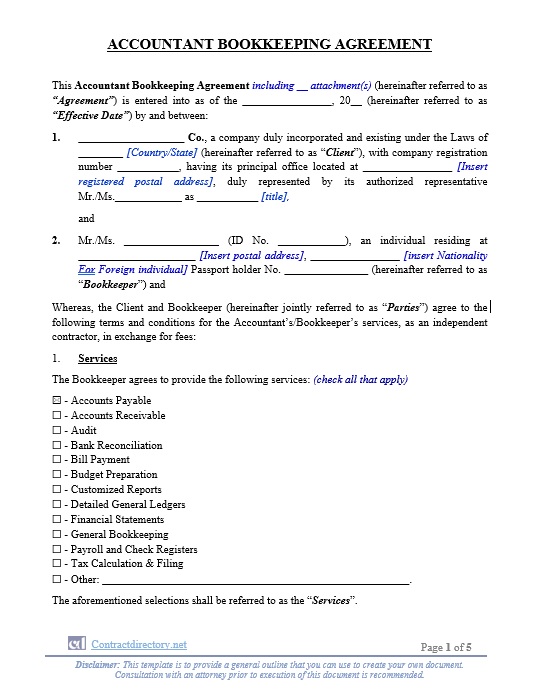
First, the Accountant Bookkeeping Agreement clarifies duties. It defines services, deadlines, and fees. Moreover, it ensures both parties understand deliverables. Consequently, this agreement protects both the client and the accountant. It prevents misunderstandings and strengthens working relationships.

Terms and Responsibilities
Next, the Accountant Bookkeeping Agreement outlines responsibilities. The accountant records transactions, reconciles accounts, and provides periodic reports. The client supplies financial data and reviews reports. Additionally, the agreement outlines specific deadlines and formats. Therefore, both parties meet expectations and avoid delays.
Fees, Payment Terms, and Liability
Then, the Accounting Services Contract states fees and timing. It states whether billing happens hourly, per month, or per project. It sets payment terms and methods clearly. Furthermore, it limits liability for errors or omissions. Also, it may include dispute resolution clauses. Ultimately, clarity here builds trust and avoids disputes.
Term, Termination, and Confidentiality
Finally, the Accounting Services Contract defines contract length and termination conditions. It includes notice periods and grounds for early exit. It also requires both parties to protect client financial data. Moreover, it forbids sharing sensitive data with third parties. Thus, it ensures confidentiality and professionalism.
Overall, the Accountant Bookkeeping Agreement or Accounting Services Contract unites the client and the accountant in mutual trust. It outlines roles, timelines, fees, liability, and data protection. Also, it guides smooth collaboration and prevents conflicts.
Check out more pages of our website for related content:
Access the Full Contract Directory Index
You can browse the complete alphabetical list of commercial, financial, and project-based contract templates in our A–Z Contract Index.
References
- QuickBooks – Bookkeeping basics: A guide for small businesses – This article explains bookkeeping fundamentals, including key terms, setup steps, best practices, and common mistakes to avoid for effective financial tracking in small businesses.
- Xero – Small business bookkeeping made simple: Your step-by-step guide – This guide covers bookkeeping methods (single-entry vs. double-entry), how to record transactions, use software for automation, and generate essential reports to manage small business finances efficiently.
- Corporate Finance Institute (CFI) – What Is Bookkeeping? Definition & Process Explained – This resource defines bookkeeping as the regular recording of financial transactions, outlines the process including daily entries and reconciliation, and highlights its role in supporting accurate reporting, tax preparation, and informed business decisions.

has been added to your cart!
have been added to your cart!

