

Tax Havens Concept
Tax havens, also known as offshore financial centres, have become key players in international finance. They allow individuals and corporations to minimise taxation while protecting wealth through secrecy and favourable laws. These jurisdictions offer little or no taxation, minimal reporting requirements, and legal structures designed to shield ownership. As a result, they attract high-net-worth individuals and multinational corporations seeking to preserve profits.
The appeal of tax havens rests on two pillars: secrecy and accessibility. Secrecy ensures that ownership structures, assets, and transactions remain hidden from domestic governments. Accessibility means that the financial system is well-connected, enabling easy transfers of capital across borders. Together, these qualities make tax havens powerful tools for those who wish to minimize their tax obligations and protect their wealth.
How Tax Havens Are Ranked
The Financial Secrecy Index (FSI), produced by the Tax Justice Network, is one of the most authoritative measures of global tax havens. It ranks jurisdictions using two criteria. The first is the Secrecy Score, which assesses a jurisdiction’s ability to conceal financial transactions. This assessment considers ownership registration, transparency of legal entities, tax regulations, and cooperation with global standards. The second is the Global Scale Weight, which measures a jurisdiction’s share of international offshore financial services based on IMF statistics.
By combining secrecy and global scale, the index highlights not just where secrecy exists, but where it has the greatest global impact. For instance, smaller countries like the Maldives and Angola score highly for secrecy, but because they represent less than 0.1% of offshore finance, their overall ranking remains low. The top 20 list instead reflects both secrecy and scale together.
The World’s Top Tax Havens
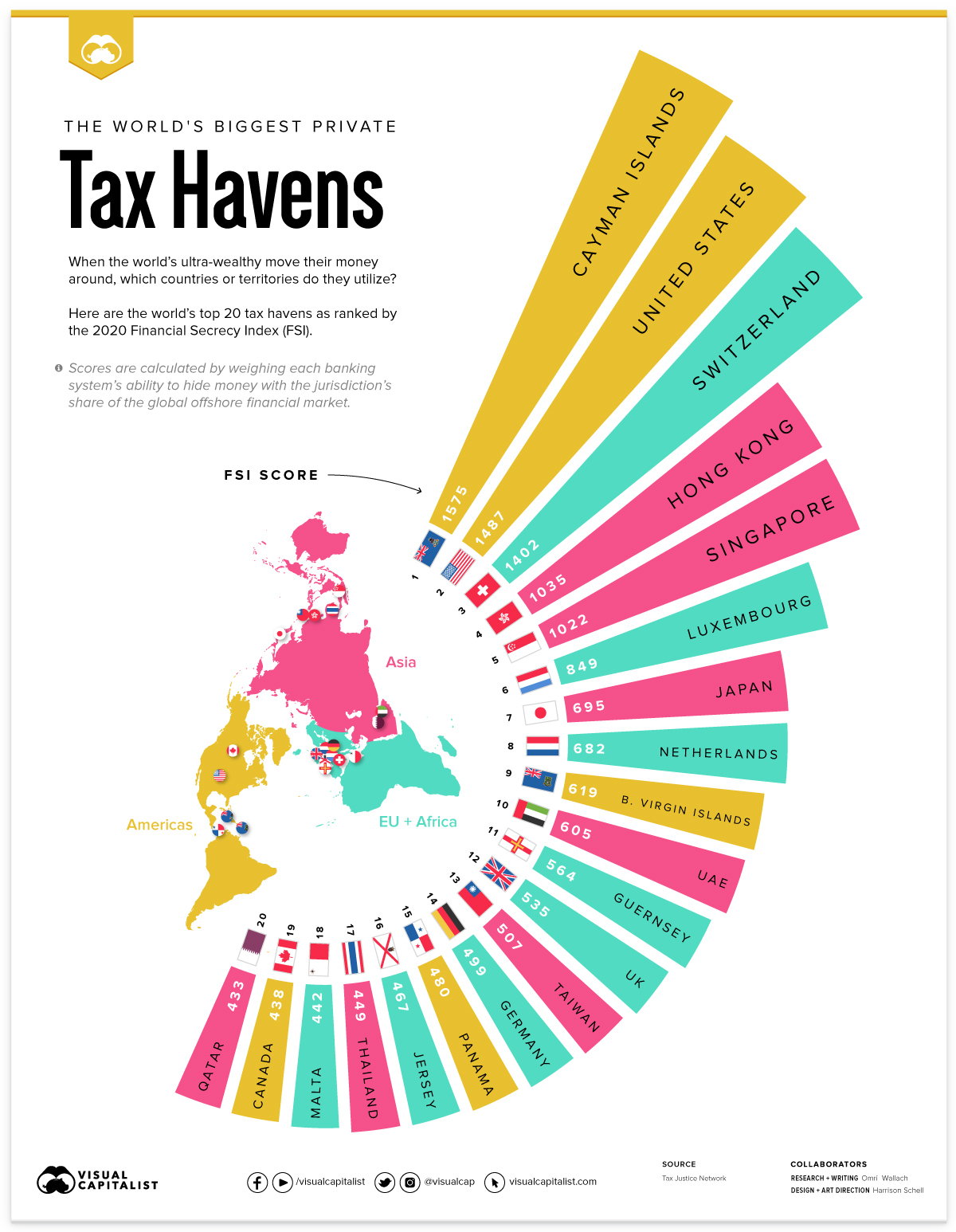
The FSI 2020 revealed a fascinating mix of expected and surprising players. At the top is the Cayman Islands, with an FSI score of 1,575. It is a hub for hedge funds and private equity, making it a central location for global capital flows. The United States ranks second with 1,487 points, thanks to states such as Delaware and South Dakota that allow anonymous trusts and entities. Switzerland, long associated with secretive banking, holds third place with 1,402 points.
Other major tax havens include Hong Kong (1,035), Singapore (1,022), and Luxembourg (849), each serving as gateways for regional capital in Asia and Europe. Japan (695), the Netherlands (682), and the British Virgin Islands (619) are also key destinations. The list continues with the United Arab Emirates (605), Guernsey (564), the United Kingdom (555), and Taiwan (523). Panama (492), Jersey (467), Thailand (449), Malta (438), Canada (433), and Qatar (433) round out the top twenty.
The geographical spread is notable. Nearly half of the top 20 are in Europe, while the rest are divided among Asia and the Americas. Many share historical ties with the United Kingdom. Alongside the UK itself, the Cayman Islands, British Virgin Islands, Guernsey, and Jersey are British Overseas Territories or Crown Dependencies. This highlights the lasting influence of British legal systems on global financial secrecy.
Individuals vs Corporations in Tax Havens
Tax havens serve both private individuals and large corporations, but their methods differ. Individuals often use offshore bank accounts or shell companies to protect wealth, inheritances, or assets from taxation. Wealthy families also relocate funds to politically stable jurisdictions where property rights remain secure.
Corporations, however, pursue more structured strategies. They incorporate subsidiaries in tax havens to hold intellectual property, manage royalties, or shift profits away from high-tax jurisdictions. The British Virgin Islands, Cayman Islands, and Bermuda consistently rank among the top corporate tax havens. By using these locations, multinational firms defer or even eliminate corporate tax liabilities.
The relativity of “tax haven” status is also important. A country may not act as a tax haven for its own citizens, but can serve as one for foreigners. For example, the United States and Canada are not havens for Americans or Canadians, yet wealthy individuals from Asia or the Middle East often use them due to gaps in foreign tax law. Similarly, the UAE has become a preferred haven for Africa’s ultra-wealthy.
Global Scrutiny and the Future of Tax Havens
The existence of tax havens has drawn increasing criticism because of the vast sums of revenue lost to governments. Trillions of dollars are estimated to be sheltered offshore, reducing funds available for public services such as healthcare and education. Critics argue that tax havens encourage inequality and undermine the social contract.
International organisations have responded with reforms. The OECD and G20 promote transparency through initiatives like the Common Reporting Standard, which mandates automatic exchange of financial data between jurisdictions. The United States enforces FATCA, requiring foreign banks to disclose accounts held by American citizens. These measures have weakened banking secrecy but have not eliminated it.
A significant breakthrough came in 2021, when the G7 reached a deal on global corporate taxation. The agreement introduced a minimum tax of 15% on multinational corporations and sought to allocate taxes based on revenue generated in each country rather than corporate headquarters. More than 130 countries, including the UK, China, India, and even the Cayman Islands, signed the deal. If implemented effectively, this framework could reshape how corporations use tax havens.
Still, the adaptability of tax havens should not be underestimated. When regulations tighten in one jurisdiction, capital often shifts to another with softer rules. Moreover, financial innovations such as cryptocurrencies create new ways to move wealth beyond traditional oversight. Therefore, while reforms may reduce the scale of abuse, the underlying demand for tax efficiency and asset protection ensures tax havens will continue to play a role.
Conclusion
Tax havens remain among the most controversial yet enduring features of the global economy. They provide secrecy and accessibility, enabling both individuals and corporations to reduce taxation and secure wealth. The top 20 havens, ranging from the Cayman Islands to the United States and Switzerland, highlight how both small islands and major powers participate in this system. The dual criteria of secrecy and scale explain why some surprising jurisdictions appear in the rankings.
The global response is intensifying, with transparency measures and global tax reform leading the charge. Nevertheless, as long as inequality, political instability, and corporate competition exist, offshore financial centres will adapt to meet demand. The tension between national tax systems and global finance will keep tax havens at the centre of debate for years to come.
References
- And Capital
- OECD – International Taxation
- IMF – Offshore Financial Centers
- Financial Secrecy Index – Tax Justice Network
- World Bank – International Finance
- Transparency International – Corruption and Tax Havens
Relevant Topics: #TaxHavens #OffshoreFinance #WealthManagement #FinancialSecrecy #GlobalTax
