Estimated reading time: 6 minutes
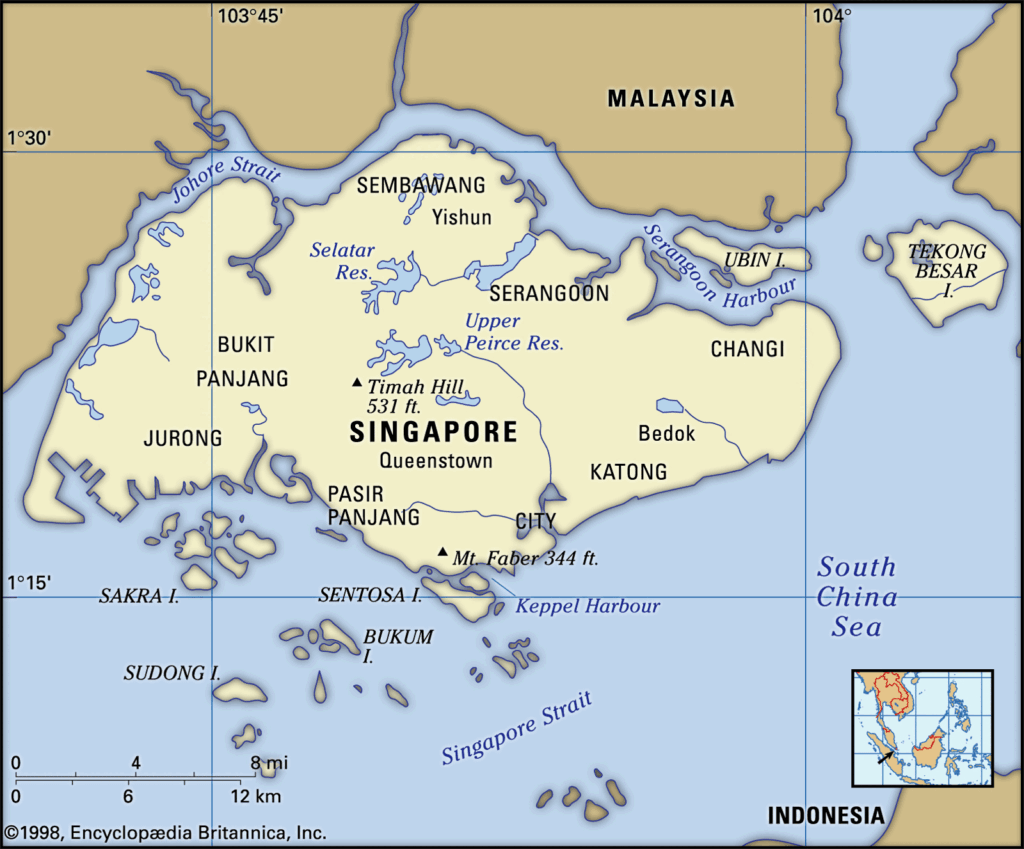
Singapore journey from a modest fishing village to a global trade hub began in 1819, when Sir Stamford Raffles established it as a British trading post in the Malacca Strait, uniting Eastern and Western commerce.
Post-independence in 1965, visionary policies transformed it into a modern economic powerhouse, leveraging its strategic location to drive exports and investment. This article provides a comprehensive guide to Singapore’s trade advantages, ports, regulations, agreements, and incentives, supported by 2024–2025 data, incorporating Double Taxation Agreements (DTAs) and essential trade platforms to serve businesses and investors negotiating the future of global trade.
1. Singapore Strategic Trade Advantages
Singapore, with a per capita GDP of USD 88,447 (2024), ranks among the world’s most competitive economies. Positioned in the Malacca Strait, it acts as a vital gateway where East meets West, facilitating trade across the Asia-Pacific and beyond. In 2024, exports reached USD 639 billion, driven by electronics, chemicals, and financial services. The nation’s free-market economy, multilingual workforce (population: 5.7 million), and 17% corporate tax rate attract global investment. By bridging markets like China and the United States, Singapore negotiates the future of global commerce, leveraging partnerships with Malaysia, the EU, and others to drive prosperity.
Primary Strengths
- Global logistics hub connecting Asia-Pacific markets
- Leading exporter of electronics, chemicals, and petrochemicals
- Skilled, multilingual workforce
- Competitive tax regime with low corporate rates
- Strong trade ties with China, Malaysia, the United States, and the EU
2. A Legacy of Trade: Singapore’s Historical Rise
From a humble fishing village to a global trade titan, Singapore’s ascent began in 1819 when Sir Stamford Raffles established it as a British trading post, capitalizing on its strategic position along the Malacca Strait. By the 19th century, it became a bustling entrepôt, attracting merchants from Asia and Europe. Post-independence in 1965, visionary leadership under Lee Kuan Yew transformed Singapore into a modern hub through industrialization, port development, and pro-trade policies. Today, its legacy as a nexus of East-West commerce continues, blending tradition with innovation to shape global trade’s future.
3. Major Ports
The Port of Singapore, one of the world’s busiest, handled over 39 million TEUs in 2024, managing 13% of global container trade. Jurong Port supports oil and chemical exports, while Tuas Terminal leverages automation for efficiency. Investments in digital systems and capacity expansion minimize congestion.
Primary Ports
- Port of Singapore: Global hub for containers and bulk cargo
- Jurong Port: Specialized in oil, chemicals, and bulk cargo
- Tuas Terminal: Automated facility for container handling
- Pasir Panjang Terminal: Essential for regional trade
4. Singapore Customs Regulations
Managed by Singapore Customs, the TradeNet system streamlines digital declarations. Goods require HS codes, detailed invoices, and permits for regulated items like pharmaceuticals and food. A 9% Goods and Services Tax (GST) ensures efficient customs clearance.
Essential Requirements
- Digital declarations via TradeNet
- Pre-shipment inspections for specific goods
- HS code classification and import permits
- Coordination with the Health Sciences Authority (HSA) for health-related goods
5. Import and Export Procedures
Singapore’s trade processes are digital and efficient. Importers and exporters register in TradeNet, submitting declarations, invoices, and certificates of origin. Coordination with logistics agents prevents delays. Strategic goods need approvals from agencies like HSA or Singapore Standards (SPRING).
Standard Documents
- Commercial Invoice (with HS codes)
- Bill of Lading
- Import/Export Declaration
- Certificate of Origin
- Packing List
- Approvals from HSA or SPRING
6. Trade Agreements & Conventions
Singapore expands market access through Free Trade Agreements (FTAs) and ASEAN membership. The Comprehensive and Progressive Agreement for Trans-Pacific Partnership (CPTPP) and the Regional Comprehensive Economic Partnership (RCEP) strengthen trade with Asia and the Pacific. Alignment with WTO, UNCTAD, and WCO ensures transparency and modern customs practices.
Major Memberships
- ASEAN: Free trade across Southeast Asia
- CPTPP and RCEP: Broad regional trade agreements
- WTO and GATT: Global trade rules and dispute resolution
- UNCTAD: Support for trade development
- FTAs: With the EU, the United States, Japan, Australia, and China
7. Export Incentives & Barriers
The Economic Development Board (EDB) and Enterprise Singapore offer tax exemptions and grants for SMEs. The Global Trader Program reduces taxes for commodity trading. High labor costs and competition from regional ports like Malaysia and Hong Kong pose challenges, requiring local expertise for compliance.
Incentives
- EDB Tax Schemes: Exemptions for international firms
- Enterprise Singapore Grants: Support for market expansion
- Global Trader Program: Tax reductions for commodity trade
Barriers
- High labor costs
- Competition with regional ports
- Strict regulations for strategic goods
8. Trade Statistics Snapshot (2024)
Singapore achieved a USD 56.8 billion trade surplus in 2024. Exports totaled USD 639 billion (electronics, chemicals, services), with imports at USD 582.2 billion (machinery, fuels). Major partners include China, Malaysia, the United States, and Hong Kong.
Essential Metrics
- Exports: USD 639 billion
- Imports: USD 582.2 billion
- Top Partners: China, Malaysia, United States, Hong Kong, EU
- Surplus: USD 56.8 billion
1
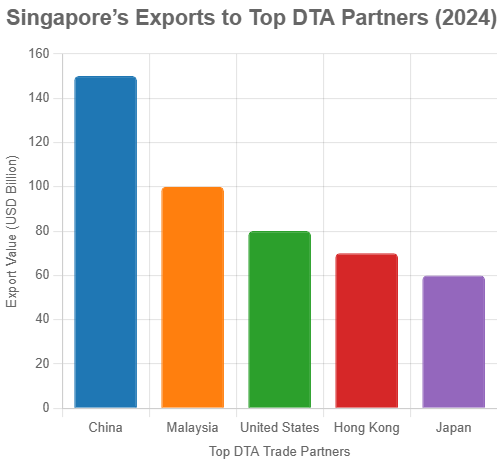
Chart: Singapore’s Exports to Top DTA Partners (2024)
The image below is a bar chart illustrating Singapore’s 2024 export values to major trade partners with DTAs:
9. Sample Trade Forms
Accurate digital submissions via Trade Net prevent fines or shipment holds. Templates are available on the Singapore Customs portal (see Section 10).
Required Forms
- Import/Export Declaration: Digital submission in Trade Net
- Commercial Invoice: Includes product details and HS codes
- Bill of Lading
- Certificate of Origin
- Packing List
10. Double Taxation Agreements (DTAs)
Singapore’s 90 DTAs, managed by the Inland Revenue Authority of Singapore (IRAS), reduce income taxes and promote investment. The Singapore-Japan DTA (1994, updated 2024) sets dividend withholding tax at 0%. A new DTA with Colombia was signed in March 2024.
Countries with Active DTAs (2024–2025)
- Australia, Austria, Belgium, Canada, China, Colombia, Denmark, Finland, France, Germany, Hong Kong, India, Indonesia, Israel, Italy, Japan, South Korea, Malaysia, Netherlands, Norway, Philippines, Portugal, Russia, South Africa, Spain, Sweden, Switzerland, Thailand, Turkey, UAE, United Kingdom, United States, Vietnam
11. Essential Websites for Exporters and Importers
These platforms, updated for 2025, streamline trade processes. TradeNet serves as Singapore’s single-window customs portal.
- TradeNet – Singapore’s single-window customs portal- manages all import and export declarations and permit applications through one integrated platform.
- Singapore Customs – the national authority responsible for enforcing customs laws, collecting duties, and implementing trade regulations.
- Enterprise Singapore – supports exporters through the Global Trader Programme and assists businesses in market expansion and export financing.
- Economic Development Board (EDB) – provides tax incentives, investment support, and strategic guidance for foreign investors and multinational exporters.
- Health Sciences Authority (HSA) – regulates health-related imports and exports, including pharmaceuticals, cosmetics, and medical devices.
- Enterprise Standards Singapore (formerly SPRING) – manages product certification, industrial standards, and conformity assessments for goods entering and leaving Singapore.
- Inland Revenue Authority of Singapore (IRAS) – oversees taxation, Double Taxation Agreements (DTAs), and international tax compliance for traders.
1
References
- Singapore International Arbitration Centre (SIAC) – Why Arbitrate in Singapore? – This article outlines Singapore’s strategic advantages, including its neutral legal framework and its status as a top-ranked global hub for resolving cross-border disputes.
- Harvard Program on Negotiation (PON) – International Negotiation: The Role of Culture in Conflict Resolution – This resource analyzes how cultural differences between Eastern and Western styles influence negotiation tactics and the building of professional relationships.
- Singapore Academy of Law (SAL) – The Development of the Singapore Legal System – This comprehensive guide explains how Singapore successfully integrated English Common Law with local commercial needs to create a unique legal environment for international business.
- Belt and Road Initiative in 2025: From Silk Road Revival to Green

