Estimated reading time: 6 minutes
Executing an industrial project, such as establishing a production unit, involves a structured sequence of interconnected stages that gradually transform an initial concept into a fully operational facility.
Moreover, this end-to-end process, typically managed under an Engineering, Procurement, and Construction (EPC) framework, ensures technical feasibility, cost efficiency, regulatory compliance, and long-term performance reliability. Furthermore, the lifecycle moves from early viability assessments to progressively detailed design, coordinated build-out, comprehensive testing, and extended warranty periods.
In addition, these stages often overlap to optimize schedules and resources while also addressing risks related to site conditions, supply variability, and construction constraints. Ultimately, the outline below presents each key phase—from the Feasibility Study to the Final Acceptance Certificate—in a clear, sequential manner.

1- Feasibility Study (FS)
This opening stage evaluates whether the proposed project is viable. It includes market studies, technical analysis, capital and operating cost projections, ROI evaluation, funding options, environmental impact assessments, and risk identification. The FS usually includes preliminary site selection and regulatory considerations. The outcome is a feasibility report that determines if the project should proceed.
2- Conceptual Design
After reviewing the FS results, the project team defines the high-level process and overall configuration. They outline the process flow, preliminary layout, major equipment requirements, and core technical alternatives. The team also uses simulations or early modelling to validate each proposed concept. The deliverable is a conceptual design package that establishes scope and direction.
3- Basic Design / Front-End Engineering Design (FEED)
The conceptual design is refined into a more detailed process framework. This includes process flow diagrams (PFDs), piping and instrumentation diagrams (P&IDs), preliminary equipment sizing, material and energy balances, and early project specifications. Cost estimates reach ±20–30% accuracy. FEED provides the technical basis for procurement and detailed engineering.
4- Detailed Engineering
Engineers create full engineering packages that include detailed drawings, equipment and material specifications, structural designs, 3D models, electrical layouts, instrumentation documents, and control-system logic. They also conduct safety studies such as HAZOP. By the end of this stage, the team finalizes every technical detail needed for procurement and construction.
5- Procurement
Materials, machinery, bulk items, and services are sourced based on detailed engineering deliverables. Activities include issuing RFQs, vendor qualification (often via an Approved Vendor List), bid evaluation, negotiation, contract award, inspections, and logistics coordination. Quality control ensures compliance with specifications.
6- Construction
Site works and physical construction commence. Civil, structural, mechanical, piping, electrical, and instrumentation teams execute all activities according to approved drawings and safety procedures. Inspectors track every milestone continuously, and supervisors monitor progress closely to keep the schedule on track and protect all quality targets.
7- Mechanical Completion
All construction and installation work for relevant units is certified as complete. Documentation, inspections, and compliance verification confirm that the plant is physically ready for testing. Mechanical Completion Certificates are typically issued by the owner’s representative.
8- Pre-Commissioning
Systems are tested individually before introducing process materials. Activities include flushing, cleaning, instrument calibration, equipment alignment, electrical integrity checks, and safety verifications. The objective is to confirm readiness for integrated commissioning.
9- Commissioning
Integrated systems are tested as a whole. Functional testing, loop checks, and subsystem verification confirm that mechanical, electrical, and control elements operate correctly together. A structured commissioning program is followed to certify the plant as safe for startup.
10- Startup
Operations begin with the introduction of feedstock and a controlled ramp-up to initial production. Trainers coach operators under real operating conditions, and engineers evaluate equipment performance under load. The team troubleshoots issues, fine-tunes the systems, and pushes the plant toward stable operation.
11- Performance Testing (Initial / Short-Term)
The operations team runs the plant under the contractual test conditions to verify the short-term performance guarantees. They measure production rate, product quality, energy efficiency, consumption ratios, emissions, and behaviour under steady-state operation. They document all results, identify any deficiencies, and correct them immediately.
12- Provisional Acceptance Certificate (PAC)
After successful startup and initial performance tests, the PAC is issued. This confirms operational readiness and triggers partial handover, milestone payments, and the start of the warranty period. Minor punch-list items may remain open.
13- Defects Liability Period (DLP) / Warranty Period
During this period, the owner operates the facility, while the contractor actively rectifies defects and supports long-term performance verification. Moreover, the DLP typically spans 12–24 months, although high-value industrial plants often require longer durations. Furthermore, the team verifies long-term guarantees such as energy efficiency, production yield, and environmental limits to ensure sustained operational reliability.
14- Final Acceptance Certificate (FAC)
Issued when the contractor completes all obligations, including long-term performance guarantees, documentation, training, repairs, and closure of all punch-list items. FAC finalizes project handover and authorizes final payment, concluding the contractor’s liabilities.
Here’s a table summarizing the stages, their standard start months (from Industrial Project initiation), and typical durations:
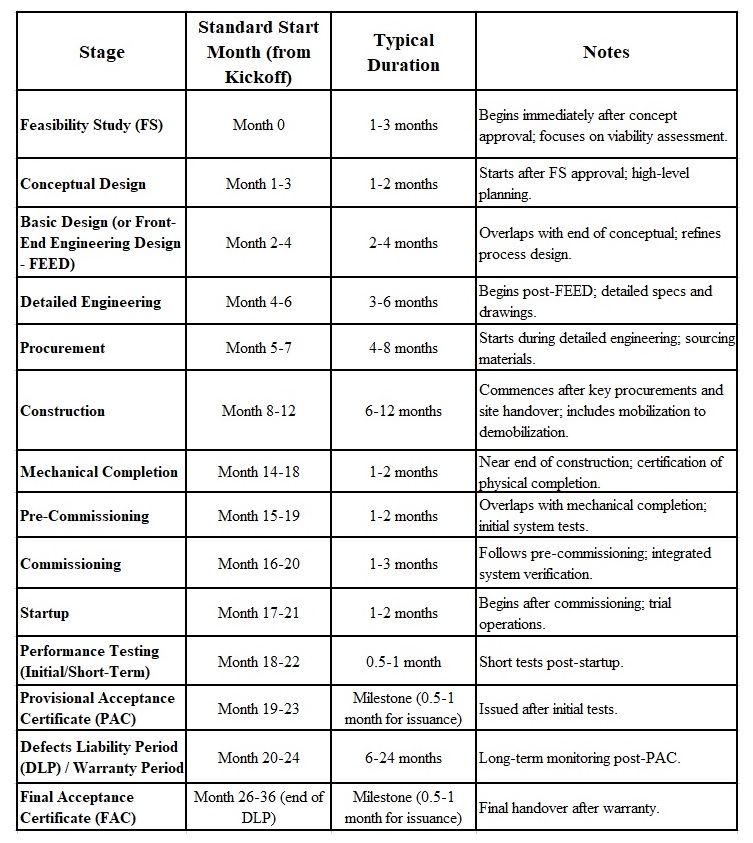
These timelines assume a 36-month total Industrial Project for illustration, but manufacturing plants often take 12-24 months from groundbreaking to operations. Schedules are optimized during front-end planning, with baseline schedules established 60-90 days after contract execution.
Final Note on Overlaps and Variability
Although these stages have defined start times as outlined above, they can and often do overlap with previous ones to optimize the overall schedule. For example, in the construction phase, the start depends on the client’s site handover, and mobilization should occur before civil drawings are ready, including site utilities like fencing, leveling, and reviews of existing as-built documents for underground and infrastructure assessments. In general, field activities in construction are highly variable and depend on client conditions, project type, terrain, and other factors.
Check out more pages of our website for related content:
- Basic Engineering Contract
- Engineering, Procurement and Construction Management Contract (EPCM)
- EPC Contract (Turnkey)
- Engineering, Procurement and Construction Contract (EPC)
- Engineering, Procurement, Construction and Finance Agreement (EPCF)
Access the Full Contract Directory Index
You can browse the complete alphabetical list of all commercial, financial, and project-based contract templates by visiting our A–Z Contract Index.
References
- United Nations Industrial Development Organization (UNIDO). “Industrial Project Preparation and Appraisal Guidelines.”
- U.S. Department of Energy (DOE). “Project Management Life Cycle – Critical Decision Stages.”
- World Economic Forum (WEF). “Delivering Large Capital Projects: Managing Risks and Improving Outcomes.”
- MIT OpenCourseWare. “Project Management for Construction and Infrastructure Projects – Execution and Control.”

