1. OECD and Its Role
The OECD (Organisation for Economic Co-operation and Development) is an intergovernmental organisation with 38 member states. One of its key functions is to regulate officially supported export credits through the OECD Arrangement on Officially Supported Export Credits.
This Arrangement defines the rules that Export Credit Agencies (ECAs) and financing banks must follow, ensuring fair competition among exporting nations. Its key principles include:
- Minimum down payment by the buyer: 15% of the contract value
- Maximum repayment period: 5–10 years, extendable to 12–14 years for major infrastructure projects
- Repayment structure: equal semi-annual instalments
- Reference interest rate: CIRR (Commercial Interest Reference Rate)
By harmonising these rules, the OECD prevents hidden subsidies and creates a level playing field for international trade finance.
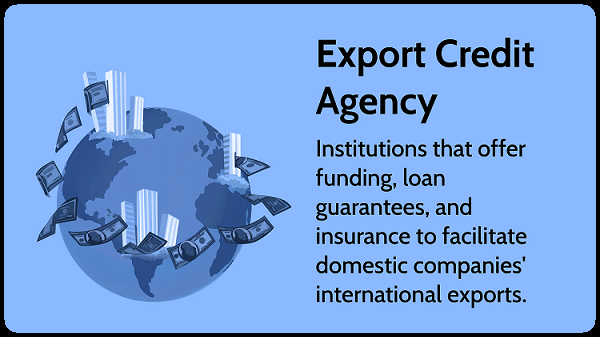
2. Role of Export Credit Agencies (ECAs)
An ECA (Export Credit Agency) is a government-owned or government-backed institution supporting national exports by providing:
- Guarantees or insurance for repayment of loans
- Coverage of commercial risks (buyer default)
- Coverage of political risks (war, sanctions, currency transfer restrictions)
Through ECA support, exporters gain certainty of payment, banks are protected from default, and buyers access competitive long-term credit.
3. Buyer (Importer)
- Defines the project or procurement and signs a contract with the exporter.
- Pays 15% down payment directly to the exporter.
- Arranges financing for the remaining 85% under ECA cover.
- Provides securities to the financing bank (collateral, local bank guarantees, or corporate guarantees).
- For large or strategic projects, arrange a Sovereign Guarantee from the host government to secure repayment.
4. Supplier / Exporter
- Delivers goods, equipment, or services as per the commercial contract.
- Submits shipping documents or progress certificates to the bank.
- Receives payment through a Letter of Credit (LC) or direct disbursement from the bank.
- Benefits from ECA support, which ensures safe and reliable payments.
5. Banks
a) Issuing Bank (LC Bank)
- Issues a Letter of Credit (LC) in favour of the exporter on the buyer’s request.
- Conducts due diligence on both buyer and exporter before issuing the LC.
- Ensures the exporter will be paid upon submission of compliant documents.
b) Financing Bank
- Provides the long-term loan covering 85% of the contract value.
- Funds the LC or makes direct payments to the exporter.
- Collects semi-annual repayments (principal + interest) from the buyer.
- If the buyer defaults, the seller claims repayment under the ECA guarantee.
(In some cases, one bank acts as both Issuing and Financing Bank. In larger projects, these roles may be separated.)
6. Sovereign Guarantee
For state-backed or large-scale infrastructure projects, the host government may issue a Sovereign Guarantee, usually via the Ministry of Finance.
- This guarantees repayment if the buyer defaults.
- It is considered the strongest security, almost eliminating risk for banks and ECAs.
7. Process Flow of an ECA-Backed Export Credit
- OECD rules establish the financing framework.
- Buyer and exporter sign the commercial contract.
- Buyer pays 15% down payment.
- Financing Bank arranges an ECA guarantee or insurance.
- Issuing Bank opens an LC in favour of the exporter.
- Exporter delivers goods/services and presents compliant documents.
- The bank pays the exporter from the loan proceeds.
- Buyer repays the loan in semi-annual instalments over 5–10 years.
- In case of default, the ECA compensates the bank, and later seeks recovery from the buyer or sovereign guarantor.
8. Final Summary
- OECD: Defines international rules for export credits.
- ECA: Government-backed insurer/guarantor covering commercial and political risks.
- Buyer: Pays 15% upfront, provides securities, and repays the loan.
- Exporter (Supplier): Delivers goods/services and receives secure payment via LC.
- Issuing Bank: Opens LC and ensures documentary compliance.
- Financing Bank: Provides the long-term loan and collects repayments.
- Government (Sovereign Guarantor): Ensures repayment for strategic projects.
In essence, ECA financing is a government-backed loan structure known as Export Credit, designed to support international trade. It provides buyers with long-term credit, exporters with payment security, and banks with risk protection under OECD rules.
9. Additional Note: Export Credit vs. Buyer’s Credit
While ECA-backed Export Credit is the most common form of officially supported financing, another product exists known as Buyer’s Credit.
- Under Export Credit, the loan is tied to an export contract, where the exporter is assured of payment through an LC, and financing is supported by an ECA. The emphasis is on protecting the exporter and promoting national exports.
- Under Buyer’s Credit, the financing is arranged directly between the buyer and the financing bank. The buyer obtains funds to pay the exporter upfront, and the repayment obligation lies solely between the buyer and the financing bank.
In short, Export Credit secures the exporter first, while Buyer’s Credit primarily benefits the importer, offering flexibility but less direct assurance for the exporter.
Note: To qualify for an Export Credit under OECD rules, the Project Owner must sign an Engineering, Procurement, Construction, and Finance Agreement (EPCF) with the Contractor.
References
- OECD
- OECD Export Credit Arrangement
- International Chamber of Commerce (ICC)
- UK Export Finance (UKEF)
- Euler Hermes (Germany ECA)
- SACE (Italy ECA)
Related Topics:
#ExportCreditLoan #OECDGuidelines #ECAFinance #ExportCreditAgency #EPCFAgreement #ProjectFinance #InfrastructureFunding #SovereignLoan #CommercialLoan #BuyerCredit #ExportFinancing #StructuredFinance #EPCContract #EPCFModel #InternationalTradeFinance #OfficiallySupportedExportCredits #OECDArrangement #DevelopmentFinance #CrossBorderProjects #PublicPrivatePartnership #ProjectFunding #LoanGuarantee #ExportSupport #TradeCreditInsurance #GlobalInfrastructure #FinancialAgreements

